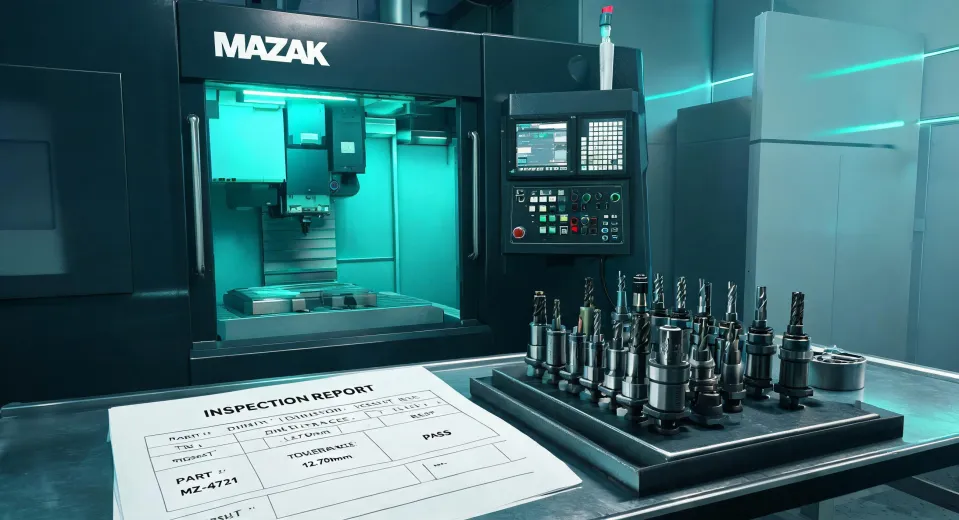
The Beginning: A Cheap Machine That Cost Me Dearly
Back in 2019, I was running a small precision machine shop — just me, two employees, and a handful of repeat customers. We did mostly CNC milling and turning for local automotive and mold shops. Business was steady, but I wanted to grow. So I made my first big mistake.
I bought a used machining center off an online auction. Not a Mazak. It was a no-name brand that looked fine in the photos but turned out to be a nightmare. Within three months, the spindle bearings failed. The controller was proprietary and the manual was in a language nobody on my team could read (note to self: never buy equipment without verifying support). That machine cost me $8,500 to purchase and another $6,200 in repairs and downtime before I finally scrapped it. I was out nearly $15,000 and had lost two good customers because of late deliveries.
The Turning Point: A High-Stakes Order and a Near Disaster
Fast forward to early 2021. I landed a contract to produce 500 aluminum housings for a medical device company — tight tolerances, complex geometry, and a ridiculous deadline. I knew my existing equipment wasn't up to the task, and I still had a sour taste from the used machine fiasco. But I was under pressure, so I rushed into buying a new CNC lathe from a dealer who promised the world. The price was low — about $68,000 — and the lead time was three weeks. That should have been a red flag.
The machine arrived on time, but within the first week of production, I had a 20% scrap rate. The turret indexing was inconsistent, the coolant system leaked, and the control interface was clunky. My operator spent more time troubleshooting than cutting metal. The customer threatened to cancel the order. I remember standing on the shop floor in February 2021, staring at a pile of rejected parts, realizing I had thrown away another chunk of capital. That experience changed how I think about machine tool purchasing.
Doing My Homework: Mazak, Laser Systems, and the Rabbit Hole of Technology
After that disaster, I decided to invest in proper research. I talked to five local job shops, visited two trade shows, and spent hours reading forums. The name that kept coming up — annoyingly, because it was also the most expensive option — was Mazak. Their reputation for reliability and the Smart Factory ecosystem intrigued me. I specifically looked at the Mazak FH-12800 horizontal machining center. The specs were impressive: 1,280 mm pallet, 60-tool magazine, and high-torque spindle capable of heavy-duty cutting. But the price tag — around $450,000 base — made me gulp.
Around the same time, I started getting inquiries from customers about laser-based processes. One wanted laser tube cutting (their part was a 1.5-inch diameter steel tube, 24 inches long). Another asked about handheld laser welding for quick repairs. That sent me down a rabbit hole of laser technology. I contacted a handheld laser welding machine manufacturer who quoted me $35,000 for a 1.5 kW unit. But their tech support couldn't answer my question about wavelength. I ended up Googling "what wavelength is co2 laser" and found out it's 10.6 micrometers — common for cutting but less so for handheld welding (those are usually fiber lasers at 1.07 μm). (Admission: I'm not a laser engineer. I still get the wavelengths mixed up. But at least I knew enough to ask.)
During this phase, I also researched laser tube cutting services in my region. I found laser tube cutting Minnetonka — a company called Midwest Laser Fab — that offered subcontracting. Their rates were reasonable, and they used a CO2 laser system. That temporarily solved my customer's need without a capital investment.
The Decision: Mazak and a Mixed Strategy
By mid-2023, I had saved enough and built a solid business case. I decided to buy a Mazak CNC lathe (the QT-250, about $120,000 including options) and a used Mazak FH-12800 that had been trade-in at a dealer. The total investment was around $350,000 — still scary, but I had learned the hard way that cutting corners on machine tools costs more in the long run. The Mazak CNC lathe price was higher than what I'd paid for the earlier junk machine, but the difference in uptime and accuracy was night and day.
Results and Reflection
Since those two Mazak machines went into production in August 2023, our scrap rate has dropped below 1%. Cycle times improved by 35%. We landed three more contracts because customers trusted our new capabilities. The FH-12800 handles those aluminum housings in 12 minutes flat — the old machine would have taken 25 minutes, if it could even hold the tolerance. And the laser work? I still outsource the tube cutting to the Minnetonka shop, but I'm thinking about buying a fiber laser for in-house welding. Maybe next year.
What I'd Tell Someone Starting Out
Looking back, here's the honest truth:
- Don't be seduced by low upfront prices. The total cost of ownership on a Mazak is often lower than a cheap machine that breaks every month.
- Know your limits. I wasted a year and $15,000 pretending I could fix a machine I didn't understand. Now I only buy from brands with local support and proven reliability.
- Laser technology is its own universe. If you're considering a handheld laser welding machine, talk to at least three manufacturers. Understand the difference between CO2 and fiber wavelengths, and never assume one size fits all.
- It took me four years and roughly $40,000 in mistakes to learn these lessons. If you're reading this and feel overwhelmed — good. That means you're doing the thinking. The best investment you can make is in your own education.
Honestly, I'm still not sure I chose the perfect machines. But for my shop, the Mazak combo was the right move. If someone has insight on whether a 5-axis would have been better, I'd love to hear it. (But don't tell my accountant.)