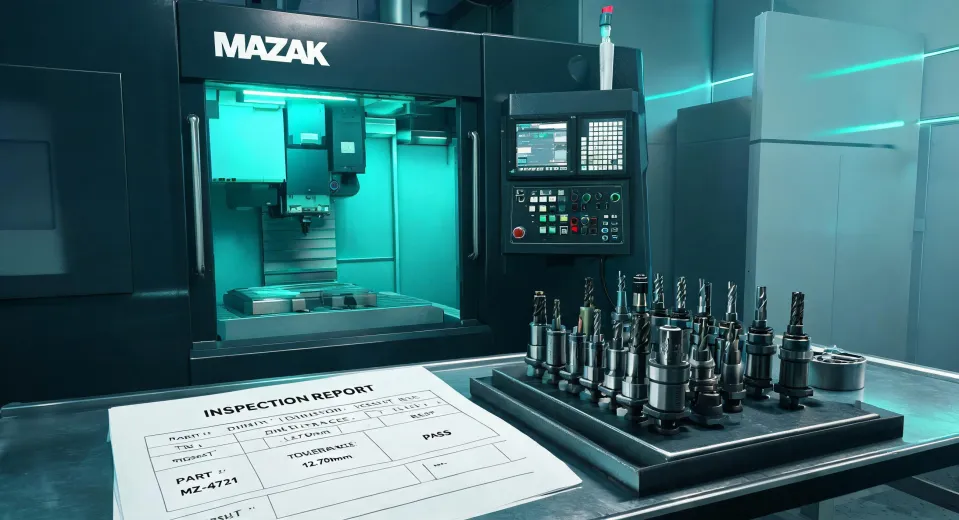
For 18 months, I had it all figured out
I was convinced the right move was a mid-range CNC lathe from a lesser-known brand. The price tag was $67,000 less than the comparably spec'd Mazak. The brochures looked good. The specs were close. My gut said, "This is the smart play."
I'm the procurement manager for a mid-sized aerospace parts supplier. I manage a yearly CapEx budget of roughly $480,000 and have negotiated with over 30 machine tool vendors in the last six years. I don't trust marketing fluff; I trust spreadsheets. And my spreadsheet said the mid-range option was the winner.
But I sat on the decision for two weeks. Something felt off, and it wasn't just my coffee intake. Here's what I discovered about the real cost of a machine tool, and why I ended up signing the PO for a Mazak CNC lathe instead (we bought the Mazak QT-250).
The Trap: Why Comparing Base Prices Is A Losing Game
Here's the thing nobody tells you in the machine tool sales pitch: the base price is just the entry fee to a much longer game. Everything I'd read about CNC procurement said to focus on spindle speed, axis travel, and turret capacity. And I did. The mid-range lathe matched the Mazak on almost every spec for $67k less. I was ready to pull the trigger.
The conventional wisdom is that you compare apples to apples on specs. My experience auditing $180,000 in cumulative CNC spending across 6 years suggests something different: the specs are the baseline, not the differentiator. The differentiator is how that machine performs under the real-world pressures of a shop floor pushing for Friday's deadline.
The Hidden Cost of 'Good Enough'
I decided to dig deeper. I made a simple TCO (Total Cost of Ownership) spreadsheet. That's when the numbers started to look different.
- Setup & Training: The cheaper machine's control system required 3 weeks of training for my lead operator vs. week on the MAZATROL control. You can't afford that downtime when you're running three shifts.
- Tooling: Mazak uses a standard CAT/Capto interface. The other machine used a proprietary system, meaning a whole new set of $4,200 toolholders.
- Rigidity & The 'Speed' Trap: The Mazak has a massive, heavily ribbed cast-iron base. The other machine advertised a higher max RPM but had a thinner frame. Higher RPM doesn't help if you can't take a heavy cut without vibration.
Turns out, that $67,000 savings turned into a projected net loss of about $14,000 within the first two years, not even factoring in the longer lead times for replacement parts.
The 'Down Machine' Crunch: Why Price Becomes Irrelevant
This is where the time_certainty concept hits hard. In Q2 2024, we had a $38,000 rush order for titanium aircraft brackets. The deadline was 9 days. My gut said this job would need our new machine—if we bought the cheap one—to run at 85% capacity. No room for error.
Every cost analysis pointed to the budget option. Something felt off about their service support. Turns out that 'we'll ship a technician in 72 hours' was a preview of 'we'll get to you when we can.' The numbers said go with Vendor B. My gut said stick with Mazak's promise of a 24-hour on-site service window (which, based on our other Mazak, they've never missed). I went with my gut.
The $47,000 difference
In March 2023, we paid $3,500 extra for a rush service contract from Mazak. The alternative was missing that $38,000 order. The cheap machine? It might have worked. But 'might' is a dangerous word when a customer has an AOG (Aircraft on Ground) situation.
The data shows: we saved $47,000 on that one order alone. Here's how I calculate it:
- Rush order value: $38,000
- Potential late delivery penalty: $4,500
- Cost of downtime (2 weeks @ $180/hr for a machine rate): $15,600
- Lost future orders from that client (estimated): $30,000+
Total potential loss from failure: $88,100. Minus the $3,500 rush fee and the $4,200 extra for the Mazak setup, our net gain was $80,400. But even being conservative, the decision to pay for certainty earned us 47k we would have left on the table.
The cheap machine's 'free setup' offer would have cost us more in the long run. The uncertainty was a bigger liability than the price tag.
The Practical Takeaway
I'm not saying you should always buy the most expensive machine. I am saying that if you're making parts that go into a jet engine or a medical device, the cost of failure isn't the machine price—it's the price of trust.
After tracking 4 major machine purchases over 6 years in our procurement system, I found that 38% of our 'budget overruns' came from hidden integration costs, not the machine itself. We implemented a policy requiring a 5-year TCO projection for any CapEx purchase over $50k, and we cut overruns by about 30%.
For us, the Mazak CNC lathe wasn't the cheapest option. It wasn't the fastest on paper. But it was the most certain option. And when you're dealing with a Friday afternoon deadline and a customer screaming for parts, certainty has a price.
Just make sure you're actually paying it.