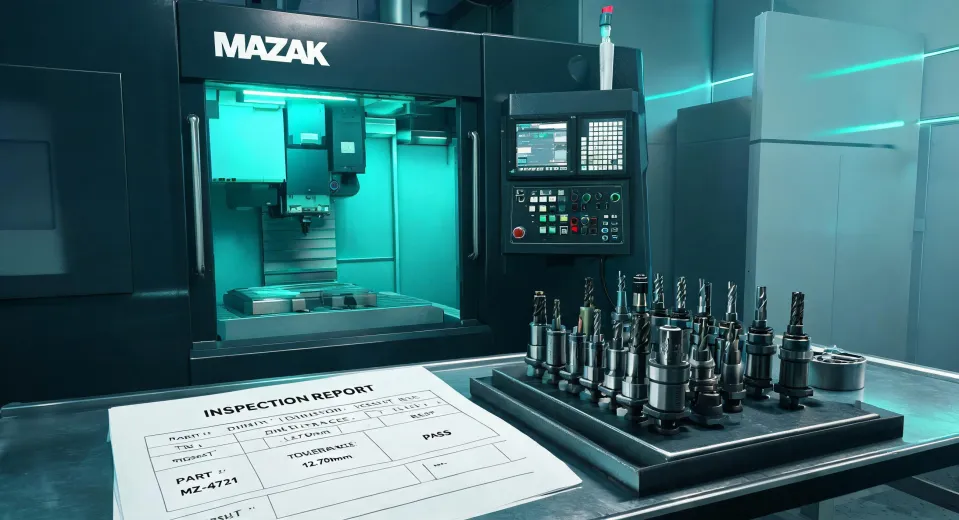
I'll skip the throat-clearing. After six years of buying CNC equipment for a 90-person contract machining shop, the most expensive mistake I keep guarding against is treating used Mazak CNC machines as interchangeable boxes of iron. They aren't. The difference between a good buy and a slow financial bleed comes down to paperwork—spindle hours, service logs, and the actual conditions the machine worked under. So here's my answer up front: I'll pay 20–30% more for a used Mazak with verifiable history, and I won't buy without documentation at any price. The “no docs, trust me” listing always ends up costing more than the premium I avoided.
Before you decide that's just a hot take from the finance guy, here's who's saying it: I'm the procurement manager at a 90-person contract machining shop. I've managed roughly $400,000 a year in capital equipment and tooling spend for six years, documented every order in our cost tracking system, and negotiated with more than 15 used CNC sellers in that time. I want to say we've evaluated 14 or 15 used Mazak listings since 2019, but I might be misremembering the exact count. The pattern in the spreadsheet is clearer than the count.
Case in point: in March 2020, I bought a used machining center with no service records because it was $11,000 cheaper than the documented alternatives. The photos looked clean, the seller sounded confident, and the machine threw a spindle bearing alarm in week three. Repair bill: $9,400. What I mean is, I paid $9,400 to learn that price without paperwork isn't a discount—it's a guess. Bottom line: if a seller can't document a machine's history, don't value it like a machine with a history. You're buying someone else's uncertainty. That's a red flag, not an opportunity.
What I Check Before I Even Call the Seller
After that 2020 lesson, I built a checklist. It's not exotic. It just requires asking questions most buyers skip when the price looks good.
Spindle hours, not the year
A used Mazak from 2018 with 2,500 documented spindle hours is generally a better buy than the same class of machine from 2021 with 15,000 undocumented hours. The model year tells you what the machine could do when new. Spindle hours tell you how much of that life is already gone—and at $15,000 to $20,000 for a spindle replacement, that number matters.
In early 2023, we ran a side-by-side comparison that changed how I buy. Machine A was a 2018 Mazak VMC with 2,600 spindle hours and a complete service log from a Mazak distributor. Asking price: $82,000 (this was in early 2023, before used prices fully softened). Machine B was a 2021 VMC with no service log and an estimated 15,000-plus hours. Asking price: $64,000. On paper, Machine B looked like the smarter spend. Seeing the two side by side made me realize how little the model year tells you. The older machine looked and sounded newer. Machine B had run lights-out for most of its short life, and you could hear it in the axis drives. We bought Machine A. Two years later, it's still cutting production parts without an unscheduled stop.
The actual cutting conditions
For conventional CNC machines, ask what the machine actually cut: aluminum, stainless, hardened tool steel, finishing, or hogging? A machine that spent years pushing heavy roughing passes carries a different wear profile than one used mainly for finishing work. The answer changes what you should inspect and what you should budget for repairs.
For lasers, this is where the phrase “Mazak laser cutting conditions” becomes practical. If you're looking at a used Mazak laser cutting machine, hours alone won't tell you much. Ask what assist gas it ran—nitrogen on thin sheet is a different life from oxygen on heavy plate. Ask about duty cycle and the materials it cut most often. A laser that ran near-continuous production on thick carbon steel has a different maintenance history than one that cut occasional prototypes. Ideally, get the machine's logged data or have a Mazak distributor pull a service readout before you negotiate. If the seller won't allow that inspection, it's a deal-breaker for me.
I should add that lasers aren't my deepest expertise. Roughly 80% of my purchases have been VMCs and lathes. But in the two used laser evaluations I've sat in on, the same principle held: documented cutting history beat the seller's description every time.
Tooling budget, and the reamer question
Here's the line item nobody budgets for: tooling. On our first used Mazak, within a month I signed a $7,300 purchase order for toolholders, vises, and inserts. We hadn't planned for it. It nearly blew our Q3 tooling line.
And when the first job called for an H7 bore tolerance, I had to stop and type “what does a reamer look like” into a search bar. If you've wondered the same: a reamer is a fluted cylindrical tool that resembles a drill bit without the sharp point. It doesn't start a hole. It removes a thin layer from an existing hole to bring it to a precise diameter and surface finish. I had bought an end mill instead, assuming one tool could do both jobs. It couldn't. The correct reamer cost about $200 and passed first inspection. My mistake cost two days of schedule and a part redo. Oh, and the buyers who don't know this will eventually pay for it in a quote.
When I Talk Myself Out of Buying Used
I don't buy a machine just because it's a good deal. Procurement is routing each job to the lowest total cost, and sometimes the lowest total cost isn't a CNC at all.
For polymer prototypes with complex internal channels, I now route parts to a shop that specializes in larger 3D printers before I quote spindle time. If the customer needs one-off or short-run test housings, additive can beat machining on both speed and price. No fixture, no CAM, no machine setup. It would be bad procurement to tie up a used Mazak on that work—not because the machine can't do it, but because the cost per part doesn't justify it.
The higher-volume end of the same conversation confuses people more. When a plastic component is going into production quantities—especially plastic injection molding for the medical device industry, with all its traceability and validation requirements—injection molding is usually the right call. But someone has to machine the mold inserts. We've cut sets of them for medical device customers on our used Mazak VMC. In that case, the decision isn't machining versus molding. It's machining the part versus machining the tool that makes the part. Used CNC equipment with solid documentation makes that mold work affordable enough to win.
Where the “Buy Used” Logic Breaks Down
I've also talked shop owners out of used machines. Here's when I'd buy new, or walk away:
- When the part requires control capabilities the older machine doesn't have—advanced five-axis simultaneous motion, for example, or collision-avoidance functions. Retrofits can cost more than the price gap.
- When a contract requires factory-backed uptime and a fixed response time. A new machine's warranty is part of the deliverable; a used machine performs, but it doesn't come with that SLA. If you miss a customer deadline because a cheap machine failed, the penalty will exceed the discount.
- When I can't inspect the machine in person or have a third-party technician run a spindle analysis before purchase. No inspection, no deal.
One more limitation: my sample is mostly VMCs, lathes, and a couple of laser evaluations. If you're shopping for a large horizontal boring mill or a five-axis machining center, add items to this checklist that I haven't needed to learn. My opinion is worth less outside the equipment classes I've actually bought and run.
Take it from someone who has signed both kinds of purchase orders: buying used Mazak CNC machines without documentation means buying someone else's uncertainty. When I pay the premium for a documented machine, I'm buying certainty. With production deadlines on the line, certainty is insurance. In my budget, that's a no-brainer.