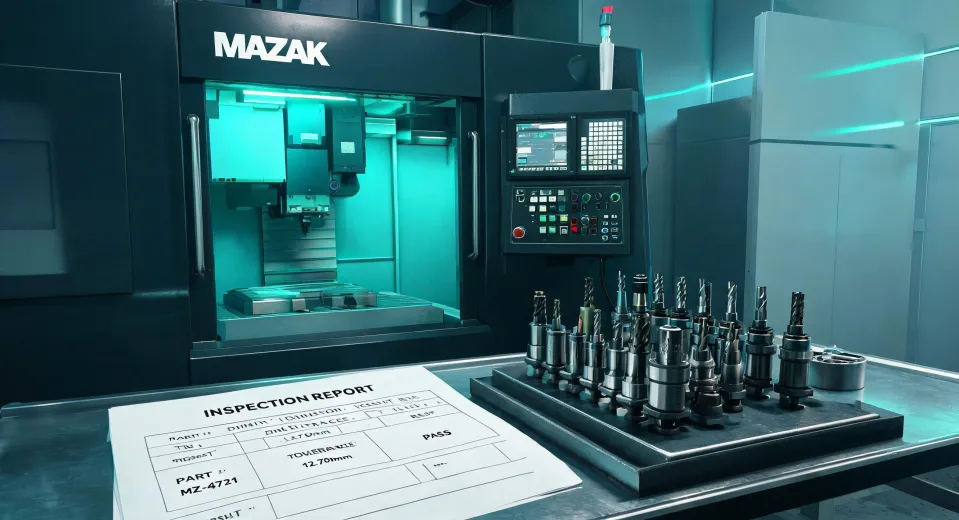
On a Tuesday morning in March 2024, our shop foreman walked into my office, dropped a printout on my desk, and said, "We need new turning tools. Seco. Here's the list." Then he left.
I have been the office administrator at a 70-person precision parts company for four years. My purchasing world was copy paper, toner, coffee, and the occasional office chair. Now I was staring at a page that said CNMG 120408-MF and DNMG 150608-MF, and I had no idea what any of it meant.
That was the start of a year that taught me more about industrial purchasing than any course could have. Seco cutting tools, a portable fiber laser engraver, a 3D printer that broke twice, and a lot of mistakes in between.
The First List: Seco Turning Tools
My first move was the obvious one. I Googled the part numbers. That led me to the seco-tools catalog, which runs about 900 pages if you download the full PDF. I printed the turning section—around 120 pages—and took it home.
Here's what I learned, slowly. "Seco cutting tools" is not one product. It's a system. Turning tools have inserts, holders, shims, clamps, and screws. The insert is the part that actually cuts. The holder carries it. If you get one part number wrong—say, the insert radius—the tool either won't cut right or will break in the first ten minutes.
I ordered what I thought was the right set. It arrived in five days. The foreman took one look and said, "These are for steel. We're cutting stainless on this job."
I said, "They're seco turning tools. The catalog says they work."
He said, "They work on steel. Stainless needs a different grade."
That was my first real lesson. "Seco turning tools" as a search term gets you to the right brand. It does not get you to the right tool. The grade—the carbide substrate and coating—matters as much as the shape.
A few months later, a tooling rep explained that ISO 513 classifies carbide grades into P (steel), M (stainless), K (cast iron), N (non-ferrous), S (superalloys), and H (hardened steel). Seco uses its own color codes on top of that. If your supplier doesn't ask what material you're cutting before quoting, they're not helping you—they're just processing an order.
Ten years ago, this was simpler. Our old distributor retired in 2020 and closed his shop. Before that, one phone call handled everything—he knew every machine on our floor and every grade we ran. Today, the catalog is online, the tools are more specialized, and the distributor doesn't visit unless you ask.
That's not a complaint. It's just the new reality. The information is out there. You just have to go get it.
The Portable Fiber Laser Engraver
Two months later, the same foreman came back. This time he wanted a portable fiber laser engraver. "For marking parts," he said. "Serial numbers, logos, that kind of thing."
Now, I want to be clear about something. I had assumed a metal cutting machine laser and a portable fiber laser engraver were the same category. They are not. A cutting laser cuts through the metal. An engraving laser marks the surface. Different power, different wavelength, different safety rules.
I ordered a portable fiber laser engraver from a supplier whose website looked professional. It arrived in a crate. The foreman opened it, read the manual for about ten minutes, and said, "This needs a 220V line and a fume extractor. We have neither."
I said, "The listing said it was portable."
"Portable means it has wheels," he said. "It doesn't mean it plugs into a wall outlet."
Two weeks and about $1,800 later—electrical work plus ventilation—we had the engraver running. It works fine now. But I should have asked two questions before ordering: what power does it need, and what ventilation does it require?
Simple questions. I didn't ask them.
The 3D Printer That Nobody Would Fix
The 3D printer was a different problem. We use it for prototyping small fixtures—nothing fancy, just quick parts for fit checks. It broke in July. I searched "who fixes 3d printers" and got three kinds of results: printer manufacturers who only service their own machines, IT companies who "support 3D printing" but really just resell them, and one guy on a classifieds site who wanted $150 just to look at it.
Eventually I found a local service company that handles 3D printers alongside other shop equipment. They charged $220 for a service call plus parts. The fix took 45 minutes.
Here's the thing. The printer cost about $2,400 new. The repair was $220. That's under 10% of the purchase price to keep a $2,400 machine out of the dumpster. It took me six weeks to find someone to do it.
Six weeks. For a phone number I could have found in an afternoon if I had started looking before the machine broke.
The Communication Problem I Didn't See Coming
In October, I finally put together what I thought was a clean purchase order. I listed seco turning tools, insert grades, and quantities. I sent it to our regular industrial supplier.
They called back the next day. "Your insert grade says P25," the rep said. "Do you want that in the Seco grade, or the ISO equivalent?"
I said, "The Seco grade."
She said, "Seco doesn't use P25. That's an ISO code. Seco has their own grade names. I need you to pick."
I had been copying ISO codes from a technical document and pasting them into a purchase order, assuming they were universal. They are not. The ISO codes describe the material class. The manufacturer grade describes the actual product. Both are real. Both matter. And I was mixing them up in the same line item.
We got it sorted out. But it cost me three days of back-and-forth.
What I Learned (And What I'd Do Differently)
Three takeaways from this year.
One: "Seco tools" is a brand. "The right tool" is a specification. The part number, the grade, the coating, and the application all have to line up. A good supplier asks about your material and your machine before quoting. If they don't, find another supplier.
Two: Equipment purchases need a checklist, not a gut feeling. For the laser engraver, I should have asked about power, ventilation, and safety. For the 3D printer, I should have found a service vendor before I needed one. For the turning tools, I should have confirmed the material grades before I confirmed the price.
Three: "Portable" and "standard" are words that hide a lot. Every time I heard one of those words, I should have asked a follow-up question. Portable on what power? Standard for what material? These aren't rhetorical questions. They have answers, and the answers change the price.
If you're the person who just got handed a purchase list that looks like mine did—part numbers you don't recognize, brands you've never heard of—here's what I'd say. Call the supplier. Ask them to explain the line item. If they can't, or won't, that's information too.
I'd rather spend 15 minutes on the phone than three weeks waiting for the wrong parts to arrive. I know that now.
A note on the numbers: the prices and service call rates above were accurate as of early 2025 in our region. Tooling and equipment prices move with material costs and availability, so verify current rates before you budget. ISO 513 classification standards are also worth checking—the codes are updated periodically, and the grade matters as much as the part number when you're ordering.