Tuesday morning, March 2024
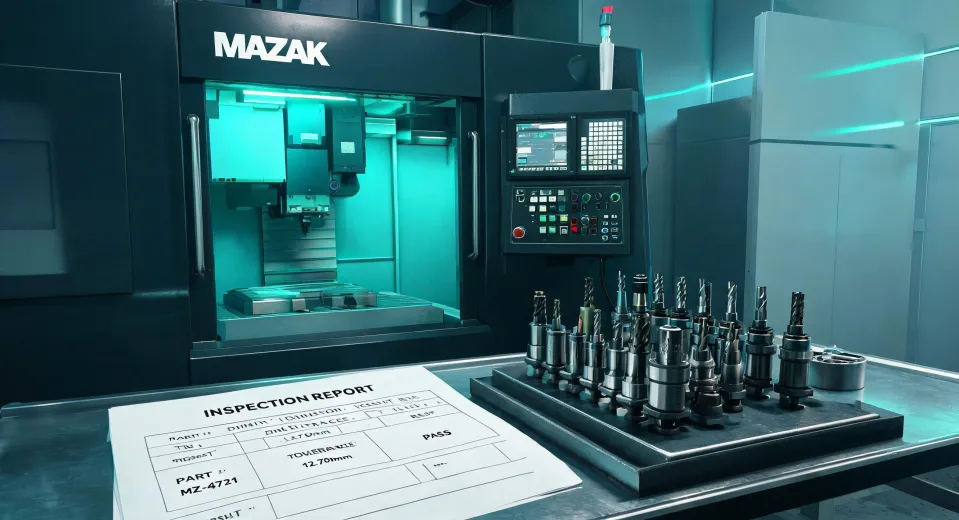
There's a wooden crate on our dock that I've been dreading. Twelve pieces of tooling in foam, and nine of them are wrong. The packing slip matches my purchase order exactly. That's the part that still stings.
I'm the office administrator for a 90-person machine shop. I'm not an engineer. I order everything that isn't raw bar stock — cutting tools, MRO supplies, calibration, service contracts, coolant, the shop towels nobody wants to think about. About $850,000 a year across 14 vendors. I answer to operations and to finance, and those two have different definitions of the word "urgent."
This is the story of how I got better at buying tools and shop equipment, told honestly, including the part where I cost the company money.
How we got here
Our three VMCs run mostly Kennametal tooling. That was true before I started and it's still true. I'd been ordering a kennametal indexable end mill body here, inserts there, a kennametal tool holder when a job needed something specific. Routine stuff. Reorder, reorder, reorder.
Then in Q3 2023 we added a 1500W laser welding tool for metalworking — repair work, tooling buildup, some hard-facing on wear parts. Nobody wanted the paperwork side of it, so it landed on my desk. Consumables, service schedule, warranty registration, training certificates. Fine. I'd figure it out.
That's the background. A shop growing a little, a tooling budget getting bigger, and me thinking of "buying tools" as a reordering job instead of a specification job.
The trap: description versus designation
Here's what I didn't get. When you order an indexable end mill, you're not ordering "a 3/4-inch end mill." You're ordering a designation string. ISO 1832 sets out how indexable inserts get named at a basic level, but the manufacturer's own catalog code is what actually controls the order — insert size, thickness, corner radius, chipbreaker, grade, handedness, and the holder interface all live in that string.
A quote summary will happily drop three characters off the end of it.
I built the PO off the quote summary. The distributor built theirs off... well, I'm still not sure, because when I asked, the answer was "the description on the RFQ." And my RFQ description said "3/4 in. carbide end mill, 4 flute, for aluminum." In a catalog, that sentence is six different part numbers.
I spent about a week going back and forth between blaming myself and blaming the distributor. Honestly, it was mostly me. I sent a description when I should've sent a part number.
The phone call
Our lead machinist called at 7:40 the next morning. Wrong corner radius on six pieces, wrong grade on three more. The nine-day lead time was now in limbo, and the job those tools were for had already been scheduled against a customer delivery date.
I didn't fully understand the value of a detailed specification until a $3,100 order came back completely wrong. That's the honest version: $3,100 in parts, a return authorization, a restocking question, and a slipped job that I had to explain to the shop supervisor and then to finance in the same afternoon.
The distributor was decent about the return. But "decent about the return" doesn't give you back the days.
The invoice nobody would pay
Same quarter, separate mess. Our maintenance contractor handles the shop's air handling — mist extraction, make-up air, filters. The invoice came in French. One line read nettoyage VMC simple flux, which is the cleaning service for the single-flow ventilation. It was bundled with filter swaps and a belt replacement on one lump-sum line, with no PO reference anywhere on the document.
Finance bounced it. Not because the work wasn't done — the contractor's tech had signed in at the gate — but because there was nothing to match it against. I spent three weeks and a lot of email getting a reissued invoice with itemized labor and materials. Meanwhile the contractor is calling me because they haven't been paid, and the shop is calling me because something is rattling above bay three.
Cost of that screwup, in my time: roughly nine hours. Not catastrophic. But it was nine hours in the same month as the tooling mess, and it's when something clicked — the invoice is part of the purchase, not an afterthought to it.
Two weeks of going back and forth
The next decision kept me up for longer than it should have. After the wrong-order episode, I had a choice: keep buying Kennametal through the established distributor, or move the standard items to a cheaper online reseller and save about 9%.
Cheaper sounded great on a spreadsheet. But the distributor was the one who would take inserts back, who had a technical rep that would tell me when my grade choice was wrong, and who would send the full spec sheet before I ordered instead of after. Two weeks of going back and forth. Ultimately I kept the distributor for anything that touches a cutting edge, and moved the plain MRO stuff — wipes, fasteners, gloves — online. The savings on the MRO line alone paid for about a third of the price gap.
But then again, if volume doubled I'd relook at the whole thing. I don't think there's a permanent answer here.
The laser question I keep getting asked
In January 2025 someone in the front office asked me: how long does a fiber laser last? I had to go read, because I didn't know.
The source is usually rated on diode life. Most source manufacturers publish something in the 100,000-hour range for pump diodes, and you should treat that as a ceiling under good conditions, not an average — it assumes clean power, proper cooling, sane duty cycle, and, the part I underestimated, clean optics.
What actually stopped our cell wasn't the source. It was a protective lens and a chiller that hadn't had its fluid changed on schedule. Fourteen months of light duty, one lens, one fluid change. Small money. But if that lens had gone another month with spatter build-up, the failure would've been further down the optics train, and that's where the labor hours live.
If you're buying one of these units, ask for the source model and the published service life in writing, then ask what the annual consumable set costs and how fast a service tech can get to you. And get the laser safety classification documented before it's energized — most industrial units land in Class 4 under IEC 60825-1, which makes the enclosure and interlocks an EHS sign-off item, not a purchasing line item.
My honest guess for a well-maintained unit in a single-shift job shop: the source outlives the rest of the cell. Don't hold me to that. I don't have the service records to prove it.
What I actually do now
None of this is clever. It's just the checklist I wish someone had handed me in 2022:
- Buy by full designation, never by description. Part number, grade, corner radius, chipbreaker, and holder interface go on the PO even when the vendor says "we know what you mean."
- Get the spec sheet before the order confirms. If a rep can't send it in a day, that tells you something.
- Price the consumables and the maintenance, not just the machine. A 1500W laser welding tool for metalworking is a $X purchase and a $Y-per-year relationship. Ask about Y first.
- No PO number, no itemized lines, no payment. I put this in writing to every new vendor before the first order, and it's cut my invoice disputes to almost nothing.
- Compare total cost, not unit price. The lowest quote I got in 2024 was also the one that couldn't produce a return authorization.
There's also a maintenance calendar taped inside my cabinet now. Ventilation cleaning, chiller fluid, lens inspection, calibration dates. It's ugly and handwritten, but nobody has asked me why an invoice got rejected in eight months.
The part I'm still not sure about
Would the checklist have caught the March crate? Probably — the designation on the PO would've at least moved the blame to the right party. What I'm sure of is that the mistake wasn't a tooling problem. It was a paperwork problem, and paperwork is the actual job.
When I told my supervisor what the wrong order cost, she said, "So you learned something." Which is what people say when they're being nicer than they have to be.