-
Who this checklist is for
-
Step 1: Define the real job—not the machine category
-
Step 2: Get a line-item quote for the machine
-
Step 3: Model the automation and software layer
-
Step 4: Price the tooling ecosystem
-
Step 5: Run the hidden cost audit
-
Step 6: Test the vendor's support math
-
Step 7: Calculate 5-year TCO and payback
-
Common mistakes I've made so you don't have to
-
Final note
Who this checklist is for
I'm a procurement manager at a 220-person precision machining company. I've managed our capital equipment and tooling budget ($2.8M annually) for 8 years, negotiated with 50+ vendors, and documented every order in our ERP cost tracking system.
This checklist is for anyone who has to sign off on a CNC machine, laser cutter, automation package, or tooling order. Seven steps. Use them before you approve the PO.
Is CNC machining expensive? Yes—if you only look at the hourly rate. No—if you price scrap, setup, tooling, integration, and downtime. The difference is TCO.
Step 1: Define the real job—not the machine category
It's tempting to start with 'I need a Mazak milling machine' or 'I need a laser.' That's the wrong first move. Start with the part, volume, tolerance, and material.
What are you actually buying? Capacity? Accuracy? Lights-out hours? A bottleneck fix? Write that down. Then ask vendors to solve that job.
I use a one-page job spec: part family, monthly volume, tightest tolerance, material, fixture needs, and automation goal. If a vendor can't map their quote to that spec, the quote isn't ready.
Step 2: Get a line-item quote for the machine
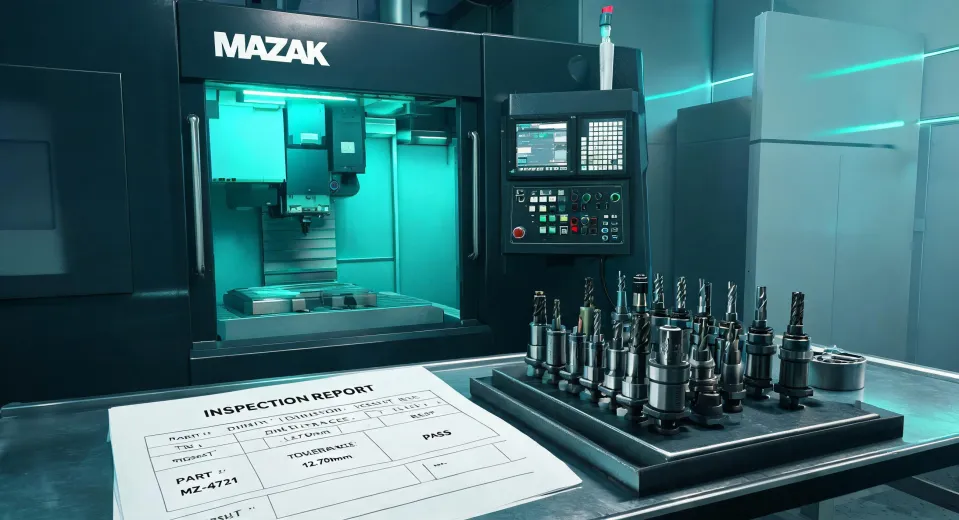
When we priced a Mazak milling machine, the base number looked fine. Then we added the options we actually needed: chip conveyor, high-pressure coolant, touch probe, tool presetter, transformer, and rigging. The signed quote was 22% above the base.
Ask for every line item. Not a bundle. Not 'standard package.' I want to see:
- Machine base and control
- Spindle options and coolant system
- Chip management and filtration
- Probing, tool setting, and verification
- Installation, foundation, and power requirements
- Freight, rigging, and startup
If a line item is 'included,' get it in writing. 'Included' is not a spec.
Step 3: Model the automation and software layer
Mazak iSmart Factory gets sold as a productivity layer. It can be. But it's not free, and it's not plug-and-play. You need network drops, machine connectivity, data licensing, and someone to own the dashboards.
In our Q3 2024 budget, we set aside 12% of machine capex for integration: IT time, PLC/MTConnect work, training, and software subscriptions. That number is not from a vendor brochure. It's from our actual invoices.
Ask three questions:
- What data leaves the machine, and who owns it?
- What happens if the software subscription lapses?
- How many internal hours per month will this take after install?
If the vendor can't answer, the automation ROI isn't real yet.
Step 4: Price the tooling ecosystem
A machine without tooling is a sculpture. I once assumed a carbide reamer set would drop into our existing holders. Didn't verify. Turned out the taper and coolant-through specs didn't match. That cost us $780 in adapters and two weeks of lead time.
In January 2025, public distributor listings for a 12-piece carbide reamer set ranged from $420 to $1,100, depending on size, coating, and tolerance. But the set is the small number. The bigger number is holders, presetters, spare inserts, and the first-year replacement rate.
Build a tooling BOM before you approve the machine. Otherwise, the tooling line will surprise you in month two.
Step 5: Run the hidden cost audit
This is the step most teams skip. The machine price is not the project price. I audit these categories every time:
- Foundation, floor prep, and vibration isolation
- Power, transformer, and electrical panel upgrades
- Compressed air, coolant, and chip handling
- Fume extraction or mist collection
- Insurance rider and facility permits
- Training travel, backfill labor, and lost production during install
- Spare parts kit and service contract
We once had a 'free installation' that required a $6,500 electrical upgrade and a $2,200 crane rental. Not free. Just reclassified.
Step 6: Test the vendor's support math
Support is a cost line, not a vibe. Ask for response-time commitments, local technician coverage, and spare-part lead times. Get it in the contract.
For accuracy, ask for test results per ISO 230-2 or ASME B5.54. Those standards give you a way to verify positioning accuracy and repeatability instead of trusting a demo. If the vendor won't provide test data, that's a data point too.
I also check the service rate. A $180/hour technician with a 4-hour response window is different from a $120/hour technician who takes three days. Multiply the difference by your downtime cost. The cheaper service contract can be the expensive one.
Step 7: Calculate 5-year TCO and payback
Now put it together. I use a simple 5-year TCO:
Purchase price + installation + tooling + software + training + power/consumables + service + downtime risk - resale value = TCO
Divide TCO by the additional good parts you expect to ship. That's your true cost per part. Compare that to your current process or outsourcing quote.
When we compared a new Mazak milling machine against outsourcing a family of parts, the machine looked expensive upfront. Over 5 years, with scrap reduction and setup time cuts, it was 18% cheaper per good part. But that only worked because we included automation and tooling in the model—not just the machine.
Common mistakes I've made so you don't have to
- Assuming 'free training' meant free. Travel, backfill, and lost production added $3,400.
- Comparing a metal fiber laser to the best industrial fabric laser cutting machine without changing specs. Different optics, different safety, different TCO.
- Skipping acceptance tests because the demo looked good. The demo is not your floor.
- Forgetting software renewals. Year two had a $4,800 line item we didn't budget.
- Letting the lowest quote skip critical options. The cheapest quote became the most expensive after integration.
Final note
Everything I'd read said get three quotes and pick the lowest. In practice, for capital equipment, the lowest quote is often the one with the biggest hidden scope. Get three quotes, yes. But normalize them line by line.
Efficiency is a cost advantage. Mazak iSmart Factory, automation, and good tooling can cut real hours from a process. But they only show up in TCO if you price them honestly. Do that before you sign. It's a lot cheaper than learning it after install.