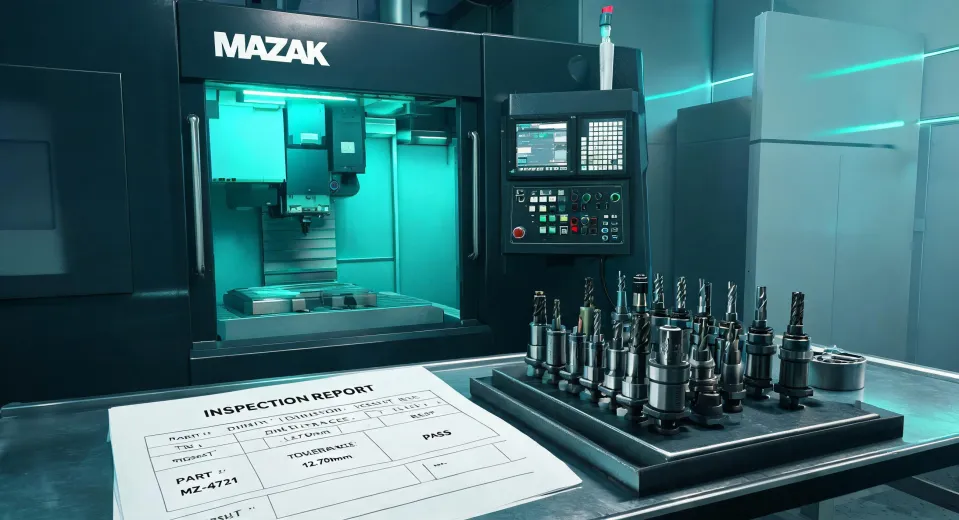
Last October I told our owner to accept a Mazak lathe quote that was roughly $48,000 higher than the lowest comparable turning machine we received. I sign the purchase orders around here, so I'm the one who has to explain budget overruns to finance. I'm not losing sleep over it. In fact, I'm making the same argument again for a fiber laser.
A guaranteed delivery date is a machine tool spec, and it's worth paying for. That sounds like a platitude until you've watched a 'subject to vessel schedule' machine slide three weeks past its promised startup date while the customer's calendar doesn't move.
Quick context so you can calibrate this opinion: I've been the purchasing administrator at a 40-person metalworking job shop since 2020. I manage roughly $2 million a year in spend across maybe 45 vendors. We buy CNC machines, cutting tools, workholding, maintenance supplies, and yes, FDM 3D printer filament, because we run a small printer for fixture prototypes. I'm not a manufacturing engineer, so I can't speak to spindle load charts or chip evacuation angles. What I can speak to is quote language. After five years of reading it, I've learned to treat the date on a PO the way our machinists treat a tolerance on a print.
What the $48,000 premium bought us
In Q4 2024 we needed to add turning capacity for a contract with a hard start date. The part was a housing with both turned and milled features, so we needed a lathe with driven tools. We took two serious quotes.
The Mazak quote, for a QT-series turning center with a bar feeder interface, came to about $346,000. The other, from an equally established brand, came to $298,000. A spreadsheet sees a $48,000 gap. I saw four line items the lower quote didn't have:
- A committed delivery date. The Mazak dealer put a calendar date and an installation window in writing. The other quote said 'estimated,' tied to a vessel schedule.
- Training. Programming training for our lead machinist was not included and would have been a roughly $6,000 add-on.
- Local response after year one. The lower quote pointed us to a national hotline. The Mazak dealer named a regional applications engineer and gave me a direct number.
- Installation coordination. Rigging, leveling, and foundation prep were in the Mazak package but listed as 'buyer responsibility' on the other quote.
After adding those back, the gap shrank to maybe $18,000. Then I added a line item that had no vendor name: the cost of being late. Our customer's penalty was $2,000 per day. If the cheaper machine arrived nine days late, its advantage disappeared. We had already lost nine production days on a machine purchase once, and I didn't want a repeat.
In March 2022 we bought a used machining center through a broker and saved about $21,500 versus dealer pricing. The rigger the broker sent damaged a way cover, support was an 800 number in another state, and we lost nine production days while paying roughly $12,000 in expedited repairs. The machine itself was fine. The deal wasn't. That experience rewired how I read equipment quotes.
People don't google 'lathe mazak' because they love orange paint. They google it because turning work has to leave the building by the date the customer wrote down. That date is the spec. Everything else is engine options.
Mazak laser cutting machine price: what I saw in writing
I know 'mazak laser cutting machine price' is what brought some of you here, so here's a real reference point. In October 2024 we requested quotes for a fiber laser to cut plate up to about one inch thick. The written Mazak dealer quote for a 10 kW laser, 4m x 2m bed, with a compact automation tower, came to around $782,000. That did not include the laser safety enclosure or fume filtration. I want to say those added roughly $55,000, but don't quote me on the exact figure. Pricing was Q4 2024 and will change; verify current numbers with a local dealer.
The competing quote was about $93,000 lower on the machine itself. But it didn't include the tower automation, which mattered for how we move material, and its support after the sale was, again, a centralized hotline. When I priced the tower and a local service contract separately, the real spread was closer to $25,000. Still real money.
Then I reran the same risk calculation. What does one week of laser downtime cost when the plate still has to be cut, formed, welded, machined, and painted by the same fixed date? The answer made the $25,000 spread look like cheap insurance.
Don't ask what a laser costs. Ask what it costs to have a fully functioning laser on a particular Tuesday. Those are different numbers, and only one of them predicts profit.
Additive vs subtractive manufacturing comparison, from the buying side
'Additive vs subtractive manufacturing comparison' makes it sound like a fight. Inside a job shop it's closer to a relay. We bought a small FDM printer in 2022, mostly to quiet the '3D printing will replace machining' crowd. It hasn't replaced anything. What it does is run unattended at night, which is the closest thing to a free shift we've found.
In February an engineer needed a six-piece fixture to prove out a new program. Paying a local machine shop would have cost about $850 and taken a week. The FDM printer made it overnight with maybe $12 worth of FDM 3D printer filament. It was good enough for the setup, and the Mazak lathe made the actual production parts to print tolerances. Neither technology 'won.' They solved different constraints.
The real value of additive, in our case, isn't the material. It's the schedule. The printer gave us a Friday night shift that doesn't require overtime or lights in the building.
Tooling: the line item that turns a good quote into an ambush
A new machine without tooling is a very expensive paperweight. A week after we signed for the Mazak lathe, our lead machinist handed me the tooling list: workholding, toolholders, inserts, and specialty items like an EMT reamer tool for deburring the ports on that housing. The total was about $32,000. None of it was exotic, and none of it appeared on the machine quote.
Machine builders sell machines. Tooling distributors sell tooling. No one sells you the completed picture unless you push for it. I almost waited to place the tooling order until the machine had a confirmed ship date. Then an installer mentioned that he regularly walks into shops with a brand-new machine and zero cutting tools on site.
So glad I ordered early. The lathe ended up arriving ahead of schedule, and if I had waited, we would have had a new machine sitting silent for two and a half weeks. That's the same certainty lesson, just with smaller numbers.
When you shouldn't pay the certainty premium
The takeaway isn't 'always buy Mazak.' It's 'buy certainty when being wrong is expensive.' If you have an in-house maintenance team, no penalty clauses in your contracts, and work that can slip a week without real damage, then a lower-priced machine with a looser delivery estimate can be the rational choice. We buy used equipment for low-utilization jobs for the same reason.
My sample is also limited: one 40-person job shop. I can't speak to a high-mix prototype house or a high-volume production facility. Your math will be different. Start with your own penalty rate, whatever that looks like, and then add the cost of every hour the machine sits idle while you wait on someone else's calendar.
I can't tell you which machine to buy. I can tell you that in machine tools, the cheapest quote is often the most expensive option once you add risk. The customer's due date doesn't care about your supplier's vessel schedule.