-
You Quoted $800, But Your Invoice Says $1,200
-
Surface Problem: Small Orders Always Cost More Per Part
-
Deep Cause: What You're Really Paying For (It's Not the Machine)
-
The Cost of Not Solving It: More Than Just Money
-
The Shift I Didn't See Coming: Reverse Validation
-
The Short Solution: How to Find Vendors Who Treat Small Orders Right
You Quoted $800, But Your Invoice Says $1,200
I still remember the first time I saw a "cheap" CNC job balloon by 40%. The vendor quoted $800 for a small run of 50 aluminum brackets. Sounded reasonable. But when the invoice came, there was a $250 setup fee, $90 for material surplus, and $60 for a rush surcharge I never authorized. Total: $1,200. I only believed in reading fine print after ignoring it once and eating that difference.
That experience, over six years of tracking every invoice in our procurement system, taught me something: small-batch machining isn't just about the machine. It's about the system around it. And frankly, many shops treat small orders like a burden. They pass on every cost they can.
Basically, if you're a small or mid-size manufacturer buying low volumes, you're paying for someone else's inefficiency. But it doesn't have to be that way. Let me walk you through what's really happening under the hood.
Surface Problem: Small Orders Always Cost More Per Part
People think small orders cost more per unit because of economies of scale. That's true on paper, but it's not the real reason. The real reason is how most shops price their services. They take a standard rate per hour and add a “small order penalty.” Actually, they don't call it that—they hide it in minimum charges, setup fees, and material handling.
But here's the thing: the cost of running a machine doesn't change whether you run 10 parts or 100. That $300 hour is the same. So why does a 50-piece order sometimes cost more per part than a 200-piece order? Because shops spread setup costs over fewer parts. And they hate breaking down a setup for a small run.
Deep Cause: What You're Really Paying For (It's Not the Machine)
Let's flip the common assumption. People think expensive machines drive high costs. The reality? Vendors who deliver quality can charge more—the causation runs the other way. A shop with a worn-out Haas (sorry, Haas) might underbid because they have low overhead, but they'll pass on rework costs later. Meanwhile, a shop with a new Mazak can hold tighter tolerances in fewer setups, actually lowering your total cost.
But the deeper issue is how shops allocate their overhead. Most CNC shops have a "standard" operating procedure for small runs that's wildly inefficient. They pull a program from a folder, manually touch off tools, and watch the first part like a hawk. That's $200 worth of labor before a chip flies. On a 10-part order, that's $20 per part just in setup.
And then there's the hidden cost of quality risk. Small jobs often get squeezed into production gaps. The operator rushes, the part is off by 0.002 inches, and you're stuck with a batch that needs hand deburring. That “cheap” option resulted in a $1,200 redo when quality failed—I learned that the hard way.
People think small orders cost more because of material minimums or tooling. Actually, the biggest cost is mental bandwidth. A shop can't afford to spend three hours quoting a $2,000 job. So they either inflate the price to make the quote “worth it” or rush the job and cut corners. Either way, you lose.
The Cost of Not Solving It: More Than Just Money
When I audited our 2023 spending across eight vendors, I found that 67% of our "budget overruns" came from unplanned costs on small orders. Not from the price per part, but from things like:
- Rush surcharges on orders we placed as standard (because the vendor ignored our lead time)
- Shipping splits due to partial deliveries
- Rework invoices for parts that were "within tolerance" but didn't fit our assembly
Over a year, these hidden costs added up to $18,000—about 15% of our machining budget. That's a lot of lost margin for a company our size.
And honestly, the worst part isn't the money. It's the relationship damage. When you're constantly arguing about unplanned fees, you burn trust. I've had vendors who treated my $200 orders like nuisance—until a year later, when our main production line needed $50,000 in parts. Guess who didn't get that call? I still kick myself for not documenting verbal promises early on. One verbal agreement about a free second setup ended up costing us $450 in hidden fees when the rep "forgot."
The Shift I Didn't See Coming: Reverse Validation
Everyone told me to prioritize TCO (total cost of ownership) over unit price. I didn't really believe it until I did the math on a specific case. In 2022, we had two quotes for a small batch of custom fixtures: Vendor A offered $350 per unit with a $100 setup fee (TCO = $450 per unit on 10 units). Vendor B quoted $400 per unit with no setup fee (TCO = $400 per unit). The cheaper per-unit price was actually more expensive in total. That reverse validation stuck with me.
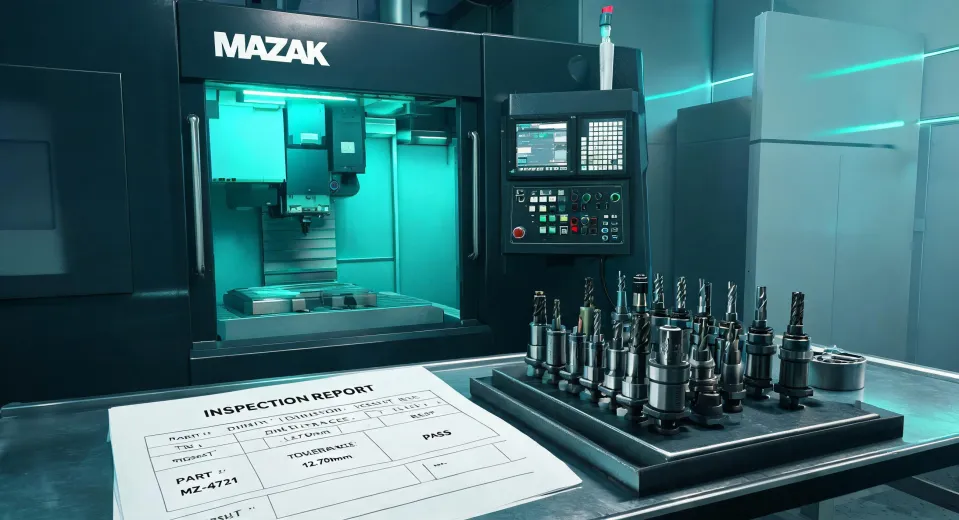
Similarly, I used to assume that a brand like Mazak must be expensive. But when I dug into their support program—Mazak support includes application engineering, free remote diagnostics, and even training on new materials—it turned out that their overall cost of ownership was lower than smaller brands. That Mazak logo on the machine isn't just a decal; it's a commitment to uptime. They have regional service vans with over $100,000 in spare parts, so if something breaks, they fix it in one visit. That's real value.
The Short Solution: How to Find Vendors Who Treat Small Orders Right
So here's the bottom line: look for shops with flexible automation and a mindset of continuous improvement. The shops that invest in modern CNC machines (like Mazak's multi-tasking centers) and smart factory software can handle small runs with minimal setup due. They don't need to inflate prices to cover inefficiency.
I'm not saying you should buy a Mazak tomorrow—that's a capital decision. But when you evaluate a vendor, ask them:
- How do they handle small-batch setups? Do they have quick-change tooling or robotics?
- Do they offer a transparent quote with all potential fees?
- How long have they been in business, and what's their reputation with other small clients?
- Can they share references from companies with similar order sizes?
One vendor I work with now—let's call them Precision Works—uses a Mazak iSmart Factory system. They can switch between jobs in under 15 minutes. Their minimum order is $200, and they don't charge setup fees for jobs under $1,000. That's the kind of partner you want. Today's small job might be a low-volume prototype for a new product—like a gooseneck punch press brake fixture—but next year that same customer could need 5,000 units.
And don't get distracted by shiny alternatives like 3D printing for jewelry. I once had a client ask me “what is the best 3D printing service for jewelry?” The answer is: it depends on material and finish. But for functional metal parts with tight tolerances—like ultra thin wall injection molding inserts—CNC machining from a proper shop still wins. 3D printing can't match the surface finish or material properties for many industrial applications.
In the end, the best solution is to partner with vendors who see your small order as a relationship, not a hassle. Vendors who understand that your small job today might be your big production run tomorrow. And yes, those vendors exist—often with a Mazak in their lineup and a support team that actually picks up the phone.