-
Two Ways to Make Metal Parts—and Why the Debate Won't Go Away
-
Dimension 1: Dimensional Accuracy and Repeatability
-
Dimension 2: Design Complexity and Geometry Freedom
-
Dimension 3: Material Integrity—the Counterintuitive Part
-
The Economics: Where "Both Are Viable" Falls Apart
-
What Should You Actually Do? A Scenario Guide
-
The Bottom Line
Two Ways to Make Metal Parts—and Why the Debate Won't Go Away
I'm a quality compliance manager at a machining company. I review every part before it reaches customers—roughly 200+ unique items a month, more than 2,000 a year. In 2024, I rejected about 4% of first deliveries, mostly for tolerance drift and surface finish issues that a proper verification plan would've caught earlier.
Lately, the same question keeps coming up from customers and startup founders: Can you print metal with a 3d printer? Yes, you can—using laser powder bed fusion, direct metal laser sintering, or binder jetting, to name three routes. But that's not the real question. The real question is whether you should print a given part, at your required tolerance, quantity, and budget.
If you've been searching for "cnc machining yc" or comparing quotes between CNC shops and 3D printing services, this comparison is for you. I'll judge both processes the way I judge parts in inspection: dimensional accuracy, design complexity, and material integrity. And I'll give you a clear answer at the end of each section—because "it depends" is technically true, but not useful.
Dimension 1: Dimensional Accuracy and Repeatability
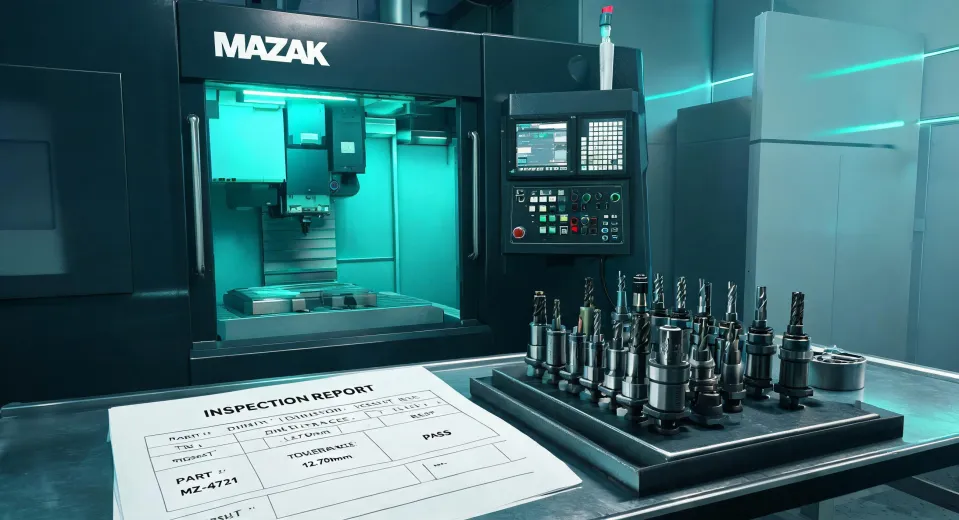
No contest here. A well-maintained cnc mazak lathe holds ±0.005 mm on turned diameters all day. Mazak has been building machines for over 60 years, and the rigid boxway construction on their lathes shows up directly in the inspection data. A modern machining center is in the same range for bores and bolt patterns.
We spec contracts against ISO 2768-mK, a common general tolerance standard that calls out ±0.1 mm for basic dimensions in the 6–30 mm range—and in practice, our CNC work lands ten times tighter. Metal 3D printing? Expect ±0.1 mm to ±0.2 mm on a good day, depending on the machine, material, and geometry.
Surface finish is the bigger gap. CNC parts come off the machine at Ra 0.4–1.6 µm. As-built printed parts are typically Ra 6–12 µm (Source: published DMLS/SLM process data, verified January 2025; values vary by vendor). That means you're scheduling secondary operations anyway—and secondary operations cost money.
Here's a pattern I see in audits every quarter: an engineer designs a 3D printed part as a "drop-in replacement" for a machined component. The CAD geometry matches. The real part doesn't. (Surprise, surprise.)
The verdict: If your part has to interface with anything—a bearing, a shaft, a mating flange—CNC machining wins for accuracy and repeatability. Full stop. If you still want to print it, fine, but you're committing to post-processing and a strict inspection plan.
Dimension 2: Design Complexity and Geometry Freedom
This is where 3D printing earns its keep. Internal cooling channels, lattice structures, undercuts that would wreck a toolpath—printing handles these without blinking. A mazak cnc machine has to reach every feature with a cutting tool, and that constraint is real.
But here's something that bothers me: people assume that because a geometry can be printed, a more complex design is automatically a better design. That's the assumption. The reality is that complexity moves risk downstream. Residual stress, trapped powder, and internal surfaces you can't inspect with standard equipment become your problem. We've rejected printed parts in incoming inspection because we couldn't validate an internal channel the design engineer swore was clear. It cost $600 per part to CT-scan, and the vendor's quality paperwork didn't tell us anything useful.
The verdict: For true geometry freedom that machining can't touch—conformal channels, topology-optimized brackets—3D printing wins. But budget for inspection, because "I designed it in CAD" is not a certification standard.
Dimension 3: Material Integrity—the Counterintuitive Part
People think 3D printed metal parts are weaker than machined ones. I've heard it from purchasing agents, senior engineers, even a metallurgist once. Actually, that's a misunderstanding of what causes failures.
The material in a printed part is usually the same alloy: 17-4 PH stainless, Ti-6Al-4V, Inconel 718. Mechanical properties can be equivalent to wrought material, sometimes better in specific build orientations. The real problem is consistency. Porosity, lack of fusion, and residual stress are process-driven, and a single bad layer can produce a part that fails at 60% of nominal strength. Statistically, the population of printed parts might be fine. The question is whether your part is the one outlier in the batch.
That's why I'd rather certify a batch of 2,000 parts off a cnc mazak lathe with a documented calibration history than a single 3D printed critical component with one build log and no destructive testing. Not because the printed part is definitely bad—because I can't predict which layer, in which part, decided to behave differently.
There's also real patent activity around quantum chaos optical fiber laser technology. A handful of quantum chaos optical fiber laser patent applications published in the last two years propose controlling chaotic beam dynamics to stabilize emission. If that matures into production-grade hardware, it could improve consistency in laser cutting and powder bed fusion alike. As of early 2025, though, it's promising research, not shop-floor reality. (And I've watched plenty of "revolutionary" laser tech never ship.)
The verdict: 3D printed metal isn't inherently weaker. It's inherently less predictable. For critical safety parts, unpredictability is a disqualifier—not because the average is bad, but because you can't tell which part is the exception.
The Economics: Where "Both Are Viable" Falls Apart
Here's a real number test. In Q3 2024, we quoted a run of 800 aluminum housings, 6061-T6, ±0.02 mm on critical bores—a complexity level right in the middle of both processes' comfort zones. CNC machining, including setup and first-article inspection, came to about $34 per part. Metal 3D printing was quoted at $96 per part—plus an average of $18 each for the machining and surface finishing we'd have needed anyway. The printed route was more than three times the total cost, with no accuracy benefit.
That pattern holds across most real projects: printing a part that still requires machining doesn't save money. It stacks costs. Figures are as of early 2025; verify current quotes—but the structure of the comparison doesn't change.
What Should You Actually Do? A Scenario Guide
- Prototype or one-off with internal complexity? Print it. You're not going to machine a conformal cooling channel economically. Just budget for post-processing and some form of internal inspection.
- Production run of 50–10,000 parts with real tolerances? CNC machining, full stop. Put it on a mazak cnc machine with probing and connected monitoring, and you get first-article data you can sign off on—and the process stays consistent for part #2,000.
- Mid-complexity, mid-volume, hybrid features? This is where the answer gets interesting. Modern multi-tasking platforms combine additive and subtractive operations in one setup. Mazak's INTEGREX line, for example, can laser-clad material onto a surface and then finish-machine it in the same cycle, while their SmartFactory software tracks tooling, offsets, and part status via MTConnect (Source: Mazak product literature, mazak.com, accessed 2025). Hybrid isn't a weak compromise—it's the honest answer to "which process is better?"
Looking back on my first few years in this role, I should have pushed for a formal first-article inspection plan much earlier. At the time, I assumed the process was stable because the supplier's paperwork said so. It wasn't. That assumption cost us a $22,000 redo and a two-week launch delay back in 2022. Now every contract includes an inspection-by-measurement plan before production starts—whether it's a CNC order or a print job. Five minutes of verification beats five days of correction. That's not a slogan; it's the difference between a clean shipment and an expensive lesson.
And for the hardware founders reading this—especially those in a YC batch or fresh out of it, trying to decide whether to buy CNC machining time or a metal 3D printer: buy time, not machines. At your volume, a contract manufacturer with Mazak-equipped machines gives you flexibility, data, and a quality system you don't have to build from scratch. If a part genuinely belongs on a 3D printer, many CNC shops (including ours) run both processes and will make the call based on measurements, not marketing.
The Bottom Line
Can you print metal with a 3d printer? Yes. Does that mean CNC machining is obsolete and every machine shop is destined for the scrap bin? No—and anyone who tells you otherwise has not inspected two thousand parts in a year.
Machining wins on precision, repeatability, and certifiability. Printing wins on geometry and low-volume complexity. The strongest strategy isn't picking a side; it's knowing which parts belong on which process, and verifying the work with data before it ships. That's prevention over cure in practice: the right process decision up front, a formal inspection plan before production, and no assumptions about supplier paperwork. It's cheaper than the alternative. I've dealt with the alternative, and it's not pretty.