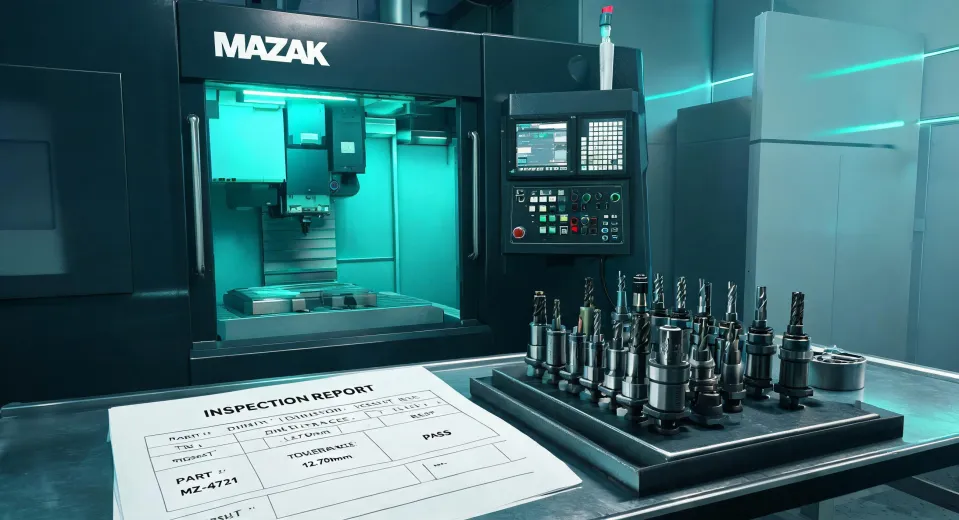
In 2017, I bought a used VMC because the price felt right. Six months later, the spindle started making noises I couldn't ignore. By the time I got it rebuilt, I'd lost two rush orders and roughly $8,000. That's when I stopped comparing sticker prices and started comparing total ownership costs.
This post is about Mazak, the alternatives I've run, and the decisions that actually matter for a small precision machining shop. It's not a settled verdict. It's a map based on mistakes.
The honest answer: it depends on the work you do
There's no single "better" option for precision machining. There's only the option that fits your tolerance requirements, your utilization, and your real cost model. Three situations cover most shops I know.
Situation 1: You're chasing aircraft or medical tolerances
For this, Mazak CNC machines are hard to beat. I've run Mazak VMCs on 6061 aluminum and P-20 steel where the print called for true position within 0.005 mm. The machine held. Day one. Day forty. After a year of constant use, the thermal stability was still there.
Are there better options than Mazak for precision machining in this space? Maybe, depending on your part size, spindle needs, and programming preferences. What I've learned is that the machine isn't the only variable. Your tooling, workholding, and inspection methods matter just as much. But you want a machine that doesn't introduce its own problems.
The total cost lesson hit me when I compared quotes for a new Mazak VMC vs. a cheaper import machine. The import was $30,000 cheaper. But the Mazak held its value better, service calls were faster, and the control made setup quicker for my team. When I factored in downtime at $120/hour, the cheaper machine was actually more expensive over a five-year window.
Situation 2: You're a general job shop on a budget
If you're cutting mostly 6061, Delrin, and 12L14 with tolerances of ±0.005" or looser, a premium Mazak might be overkill. A lighter-duty VMC will get you there for less money. The catch is hidden cost. Power draw is lower on a smaller machine, but tool changes can be slower. Setup time might be longer if the control feels unfamiliar.
I made the mistake of assuming a more expensive machine would make my life easier. It didn't. It just made my overhead higher. I know a few shop owners who run rebuilt or lower-cost machines and do just fine because their work doesn't demand high-cycle, high-accuracy machining.
But—and this is a big but—if you plan to grow into tighter tolerances or unattended running, a Mazak gives you a smoother upgrade path. Buying a cheap machine first can be a false economy if you sell it within three years and lose money on depreciation.
Situation 3: You make molds and run low-volume plastic parts
This is where my own background comes in. I spent the last three years making aluminum and pre-hardened steel molds for low-run injection molding. The VMC is the heart of that workflow.
For a small mold, you need a machine with decent rigidity, good surface finish, and reliable repeatability when you come back to a partially finished mold after a day of other jobs. A Mazak VMC fits that role well. The controls are logical, the rigidity is excellent, and the machine doesn't move once you set your zero.
For low-run injection molding, the mold doesn't need to be hardened steel. Aluminum molds can handle 100 to perhaps 2,000 parts depending on the material. That changes the math. Instead of spending $15,000 on a hardened steel mold, you can machine an aluminum mold in your own shop and produce a few hundred parts. The setup money goes into your machining time, not into an outside die shop.
One of the larger costs I overlooked on low-run jobs was tooling for the mold itself. That's where the reamer comes in.
How to use a reamer bit without ruining your mold
The first time I used a reamer bit, I did it wrong. It was a 1/4" reamer in a steel mold core, and I ran it at drill speed without enough stock left in the hole. The reamer grabbed, chattered, and left a bell-mouth hole that scraped the ejection pin. The part failed inspection. $700 of material and 10 hours of machining went into a paperweight. That's the kind of mistake that teaches you to respect tooling.
Here's what works for me now:
- Drill the hole about 0.005–0.008" undersized for a 1/4" reamer in steel. Check the manufacturer's data for other sizes.
- Leave at least 2–3 times the diameter of straight entry wall if you can. Reamers need clean alignment.
- Slow the spindle down. For a 1/4" reamer in mild steel, run around 400–600 RPM, not the 1,200 RPM you'd use for a drill.
- Feed at 0.001–0.003 inches per revolution for steel. Too slow and the reamer will rub and work-harden the surface. Too fast and you'll get a rough finish.
- Use cutting fluid. Flood is best. If you can't flood, use a heavy mist.
- Finish the bore with a single pass. Don't spin the reamer in reverse to clear chips.
If you're using a CNC VMC, you can also program a small stop at the bottom to eliminate spring-back. But for most low-run molds, a straight ream is fine.
How to decide which situation you're in
Ask yourself these three questions:
- What's your most demanding tolerance band? If it's under 0.005 mm or requires true position on tight hole patterns, you need a rigid machine with good thermal compensation. Mazak and its peers qualify.
- How many hours will the machine actually run? A machine running one shift, five days a week, doesn't need the same endurance as one running lights-out.
- What's your five-year cost envelope? Include purchase, install, tooling, programming, maintenance, downtime, and resale. The sticker price is just the entry ticket.
I can only speak to my context: a mid-size job shop doing some aerospace, some custom automation parts, and low-run injection molding. If your situation is different—say, you're a high-production automotive supplier—the math changes. The best move is to get quotes for both Mazak and alternatives, then model the five-year cost before you commit.
I didn't buy a Mazak because it was the most impressive machine on the floor. I bought it because the total cost model made sense for my work. And I also learned that the operator matters more than the brand. A skilled person on a mid-range VMC will beat a lazy operator on a five-axis Mazak. Tooling matters. Workholding matters. Inspection matters. The machine is one piece of the system.
If you're a VMC creator—someone who programs and runs vertical machining centers every day—don't let the brand wars distract you. Define your tolerances, calculate the real cost, and choose the tool that fits your system. That's how you avoid the mistakes that eat your budget.