After five years of buying custom parts for a 40-person manufacturing company, I have one hard rule: buy a machine only if it can run more than 200 hours a year; otherwise, use a CNC precision machining service factory. That line has saved us from wasting money on equipment we didn't need and kept our small orders moving at a reasonable price. It's also why, when R&D asked me to source a custom 3D printer shaft coupler in a run of 40 pieces, I didn't even flinch.
When I took over purchasing in 2020, I managed orders for metal parts, plastic parts, and the occasional mechanical service call—roughly $300,000 a year across six different vendors. I report to both operations and finance, which means I have to balance speed, cost, and traceability. In that time, I've made mistakes, changed my mind, and learned that small orders are not a favor. They're a legitimate part of a healthy supply chain.
The machine trap
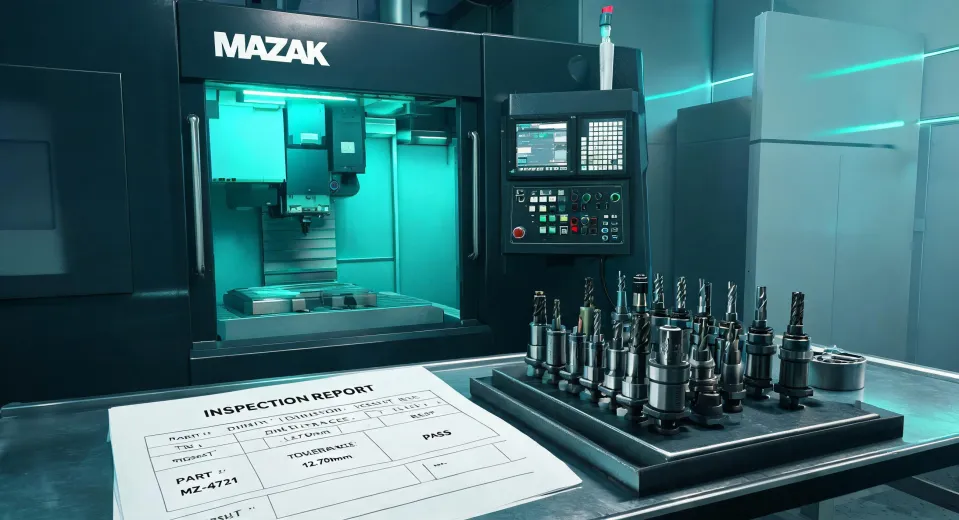
People think buying a CNC Mazak machine is what gives you precision. Actually, the machine makes it possible, but the real precision comes from the operator, the tooling, the fixture, and the inspection routine. The causation runs the other way: a shop that can handle tight tolerances buys good equipment because it needs it, not the other way around.
Don't get me wrong. A Mazak machining center in the hands of someone who knows what they're doing is a fantastic tool. But it's a tool. If I buy one and put it in a garage, I'm not suddenly a precision machine shop. I'm just someone with an expensive machine and a steep learning curve. That's why the 200-hour rule works for us.
Before you assume a CNC Mazak machine is out of your budget, get a quote from a service shop first. It surprised me how often a local job shop with a 2020 Mazak machine can beat the cost of a low-volume in-house setup, because they already bought the tooling and have the skills. (I ran that math on a 60-part order for a fixture plate; the service shop was 40% cheaper than our own cost would have been.)
Fiber laser vs plasma cutter: it's not an argument
When people ask me about fiber laser vs plasma cutter, I usually answer with a question: what are you cutting, and how much cleanup are you willing to do? For tube and thin sheet, a fiber laser—especially a Mazak tube laser if you're cutting square or round tube—produces edges that are ready to weld or assemble. Plasma can cut thick plate quickly, but the edge quality is rougher and you often add a secondary operation. As of January 2025, many fabricators still use plasma for steel plate over one inch; it's faster at that thickness and the upfront cost is lower.
Here's the part that surprised me: speed on the machine isn't the same as speed per part. My vendor cut 15 steel tubes on a Mazak tube laser in an afternoon. The previous plasma shop needed a day to do the same job because the dross had to be ground off. The laser cost more per machine hour, but the finished parts were cheaper. That's the metric that matters.
On a fiber laser, the edge is consistent enough that you can skip deburring. On plasma, you often need a grinder or a secondary pass, and that added labor eats any perceived savings. In one quote, plasma looked cheaper per part until the vendor added 'light deburr' as a line item. After that, the laser quote was actually the better deal.
How I vet a CNC precision machining service factory
Three things: geometry, material, and finish. In that order. I used to start with price, which was a mistake. Now I ask for a quote based on a drawing and then follow up with questions:
- What machine will you run it on?
- Who verifies the first article?
- What do you do if a dimension is out of spec?
If a shop can't answer those, it doesn't matter whether they have three CNC Mazak machines or an entire smart factory. The answers tell me more about their process than their brochure does. (I learned that after a $600 mistake, but more on that below.)
One of our small runs was a custom 3D printer shaft coupler. The design called for a flexure pattern that had to be milled, not printed, because the customer wanted it in aluminum. The first shop quoted $80 each and said it would take two weeks. The shop we ended up using charged $52 each, ran it on a CNC Mazak machine, and delivered in four days. The difference wasn't the machine—it was the way the owner treated a small order like a real project.
According to Mazak (mazak.com, accessed January 2025), their laser machines are part of a connected smart factory. I've never run one myself. I just know that the service shop we use has a Mazak tube laser and the scheduling software behind it means my parts show up when they say they will. As a buyer, that predictability is worth more than another decimal of accuracy.
Specs, tolerances, lead times. Verify them.
In my first year, I made the classic specification error: assumed 'standard' meant the same thing to every vendor. I asked for 'standard anodizing' and got a finish that looked great for a week, then started to wear. Finance ended up paying $600 for replacements and I ate the overtime in the department budget. Now I ask for the specific mill spec or I don't use the word standard.
The same goes for lead times. A 5-day lead time from one shop might mean 5 business days. From another, it might mean 5 days after they get around to cutting the material. Which is why I now put requested ship date and the word 'verified' in every purchase order. That's it. That one word has eliminated more headaches than any other change I've made.
The boundary of my 200-hour rule
To be fair, the 200-hour rule isn't universal. If you're a contract manufacturer with a steady stream of work and three shifts to keep busy, buying your own Mazak machining center or a tube laser can absolutely make sense. The math changes when you can spread the asset across hundreds of paying jobs.
If you're a small company making prototypes and jigs, or if you just need a custom 3D printer shaft coupler for an internal project, you're probably better off paying a CNC precision machining service factory. The cost per piece is higher, but the total cost is lower because you don't pay for the machine, the tooling, the programmer, the maintenance, and the years of experience that come with it.
One more thing: small orders deserve good service, not because they're profitable, but because they reveal how a supplier treats a customer. When I started out, the vendors who took my $200 orders seriously are the ones I still call for $20,000 orders. Small doesn't mean unimportant; it means potential.