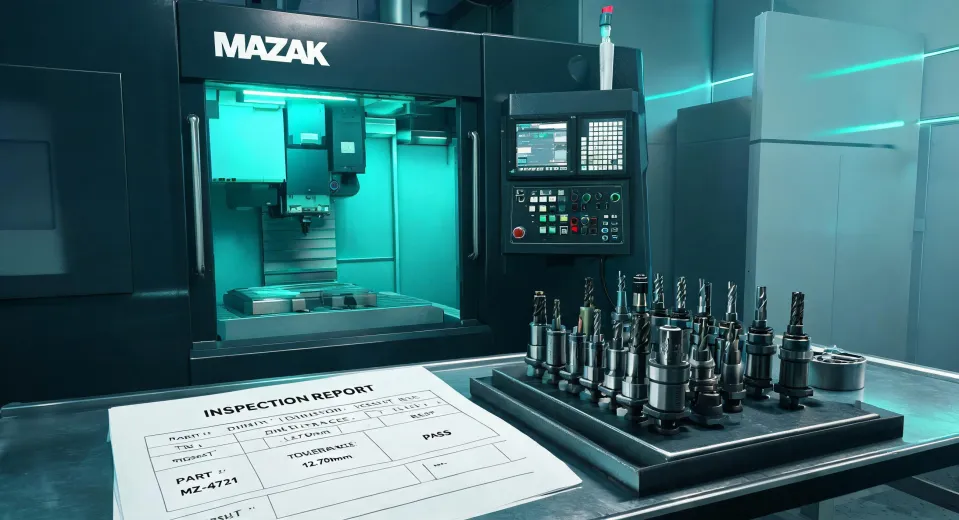
I handle purchasing for a 30-person precision machining shop. About $1.5M in orders a year, 40-something vendors, and I report to both operations and finance. I'm used to getting a straight answer out of anybody.
Then our production manager said something that became a project title in my spreadsheet:
"We need five-axis capability. We're paying $140 an hour to outsource parts we should be making ourselves."
So I did what you probably just did. I typed the search:
"mazak 5 axis cnc machine price"
Nothing. No number. No range. Not even a "request a quote" page with a hint. I tried "cnc lathe machine price list"—same wall. Then "used mazak lathe for sale", which gave me plenty of listings and zero clarity on actual cost.
Eight weeks and a lot of phone calls later, I understand why those searches don't work. It's not a conspiracy. It's that the machine price is genuinely the least useful number in the whole project. (That realization is what this article is about.)
A 5-Axis Machine Is Not a Product. It's a Menu.
A Mazak 5-axis isn't one thing—not the way "a laser printer" is one thing. It's a family. The VARIAXIS line alone covers everything from a compact tilting-table vertical machining center to a large machine with pallet changers and multi-meter work envelopes. The INTEGREX series blends turning and milling into a single setup. HCN horizontals bring five-axis cutting to prismatic parts at higher volumes. All of them are Mazaks. All of them are "5-axis." And their prices are not adjacent to each other.
Every machine is effectively a configuration: spindle speed, taper size, tool capacity, coolant pressure, chip management, pallet size, control options. A "Mazak 5-axis" can be a $300,000 machine or a seven-figure one. Both exist. The first quote I got was for a configuration that couldn't have handled 80% of our actual workpiece list. Great price, though.
The Machine Is Half the Budget
Once I realized the base machine number was just a down payment on the real project, I started asking for itemized quotes. The machine itself ended up being roughly 60–65% of the first-year total. The rest was infrastructure:
Tooling is where it gets uncomfortable. A single 1/2" carbide end mill costs $40–60 depending on geometry and coating. Fine, until you face the difference between proper and improper running parameters. Published recommendations for 1/2 carbide end mill speeds and feeds in 6061 aluminum are roughly 8,000–12,000 RPM at 50–100 IPM feed (Source: major cutting tool manufacturers' speed/feed charts, 2025; always verify against your specific tool supplier's data). Run outside those numbers and tool consumption doubles or triples. That $50 tool becomes a $0.50-per-part cost instead of $0.10. On a 10,000-part annual run, that's a line item nobody planned for.
Then there's workholding: vises, fixtures, tool holders, probes. CAM software and a post-processor for the controller—this one surprised me, since the software ecosystem can easily exceed $15,000. Installation, rigging, electrical service, compressed air, chip and coolant systems. And training, because 5-axis programming is not a natural extension of 3-axis for most operators.
Used Machines Are a Siren Song
Somewhere around quote round three, my spreadsheet asked the obvious question: why not buy a used mazak lathe for sale at 50–65% of new pricing? (Dealer price lists as of early 2025 showed roughly that spread for well-maintained late-model equipment; verify current listings, of course.)
Used CNC gear from a good brand can be an excellent buy. It can also be a very expensive education. The difference is evidence.
I found a Mazak lathe, three years old, "lightly used" per the listing, immaculate in the photos. We paid for an independent machine inspection—about $1,500 plus the technician's travel. The sales rep thought I was being absurd. The inspection found a spindle bearing fault pattern (consistent with a past crash), measurable X-axis backlash, and a door interlock zip-tied closed. Estimated repair bill: $27,000.
I walked. The $1,500 turned out to be the best money we spent in that entire evaluation cycle.
The Laser Question Everyone Asks (and Why It's the Wrong Category)
In the middle of all this, our shop manager asked a fair question: do we actually need a machining center, or would a laser do the job? That led me down a rabbit hole that included the exact search I've seen in forums: "is erbium laser a co2 laser?"
Short answer: no. Er:YAG is a solid-state laser at 2,940 nm. CO2 is a gas laser at 10,600 nm. Different wavelengths, different absorption, different applications entirely. Industrial metal cutting mostly runs on fiber lasers at 1,064 nm, with some CO2 for sheet metal applications.
But the deeper issue is category confusion. A laser is not a cheaper version of a machining center. Lasers cut profiles in sheet stock. A 5-axis mill can pocket, drill, tap, contour, hold tight tolerances, and create geometry a laser physically can't. Choosing between them based on "which costs less" is exactly how people end up paying for the wrong tool.
What Chasing the Sticker Price Actually Costs
Here's what I found while researching. Four ways this goes wrong: wrong specification. Tooling without parameters. Wrong process. Used equipment without evidence. Let me put real numbers on each.
Wrong specification. A machine chosen on price alone will relegate 10–20% of your jobs to outside vendors at $80–$150 per hour. (In our 2024 vendor review, outsourced five-axis work averaged more than $120/hour.) Twenty hours a month of outside work is $2,400 a month, roughly. In three years, that's more than the upgrade the machine should have had at purchase time.
Tooling without parameters. Operators who don't know the right 1/2 carbide end mill speeds and feeds burn through tools at double or triple the rate. It's invisible in the quote, and it's brutal in the annual spend.
Wrong process. Buying a laser because the price-per-part looked cheaper, when your actual parts need drilled holes and tapped threads—that's not a machine purchase, it's a museum donation.
Used equipment without evidence. That $27,000 repair estimate didn't land on our P&L. But plenty of shops eat that cost because the inspection was skipped to "save" $1,500. The savings evaporate. The machine sits.
The common thread in every case: the purchase price was clear. The true cost wasn't. The sticker price is honest—it's just incomplete.
What I'd Actually Do Next Time
If you're in my seat (and if you're reading this, you probably are), here's the condensed version of what actually worked for us:
- Start with parts, not models. Pull your ten most complex parts—plus the parts you expect in the next three years. That defines envelope, spindle, axis count, and automation. Then the machine model is obvious.
- Build a first-year-total-cost sheet. Machine, tooling, workholding, CAM plus post-processor, installation, training, and a year of service. The total is the price. The quote is just a component.
- Respect the tooling math. Know the recommended speeds and feeds for your primary materials before the machine lands. A 1/2" carbide end mill is an asset at the right RPM and feed, and an expense at the wrong ones.
- Buy used with evidence or not at all. Inspection, service records, spindle test. $1,500 now beats $27,000 later.
- Demand a test cut. Have the dealer run your actual parts on the actual machine before you sign anything. We were a 30-person shop, not a Tier-1 supplier—and the Mazak distributor treated the test-cut request like a normal part of the conversation. That's how it should be, and it's worth doing business with someone who sees it the same way.
The mazak 5 axis cnc machine price is never going to show up as a single search result. It's not a number you look up—it's a number you build, from your parts, your tooling, your software, and your people's skills. It's more work than a Google search. But it's the only way to get a price that's actually right for your shop.