The Phone Rang at 9:14 PM
Friday night. I was halfway out the shop door when my phone lit up with a number I didn't recognize. I almost let it go to voicemail.
Glad I didn't.
The caller was Marcus. He runs a medical device startup with exactly four employees. I'd met him six weeks earlier at a trade show, where he'd handed me a card and said, "I'll probably need you someday." That day was now.
"Look," he said, words tumbling out. "We have a demo in front of a potential investor on Monday morning. Our prototype housing is held together with zip ties. I need real metal parts. And I have no idea who else to call."
Here's the thing about my job. I coordinate production at a precision machine shop in Ohio, and I've handled roughly 200 rush orders in 12 years. In March 2024, we turned around a replacement spindle housing for an automotive plant with 36 hours to spare. Last quarter alone, we processed 47 rush jobs with 95% on-time delivery. I know how to triage an emergency.
But this one was different in a way that had nothing to do with the engineering.
Marcus's entire company could fit in a coworking booth. His order would be about $1,200. Our average job runs closer to $12,000. The sales part of my brain whispered: this is a distraction. The pause stretched long enough that Marcus said, "You still there?"
Then the other part of my brain kicked in. When I was starting out, the vendors who treated my $200 orders seriously are the ones I still use for $20,000 orders. Small doesn't mean unimportant. It means potential.
I said yes.
Why the Mazak Was the Obvious Call
The specs arrived at 9:31 PM. Two components: a stepped shaft of 316 stainless steel and a thin aluminum mounting plate. The shaft was the real challenge—45 millimeters long, with a critical diameter tolerance of ±0.01 mm, a thread on one end, and a hex head on the other.
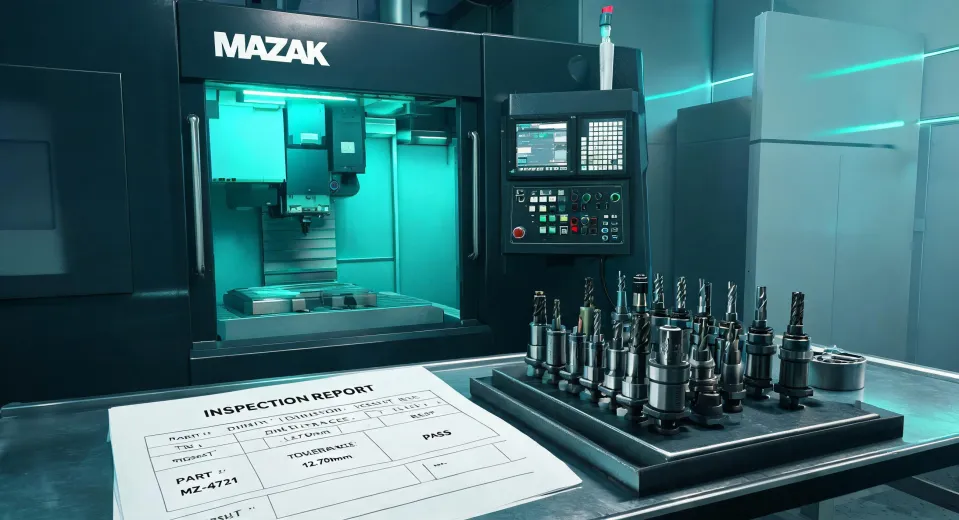
That's a CNC turning center job. Easy call. Because we run a Mazak.
And before anybody asks: yes, I've looked into better options than Mazak for precision machining. I've tested other brands—some of them 20% cheaper—on jobs that made sense for them. For high-speed aluminum work, there are machines that beat our Mazak QUICK TURN hands down. But for a part like this, on a deadline like this? No contest.
Look, I'm not here to write the brand's marketing copy. I'm here to tell you what 12 years of rush jobs have taught me. A Mazak holds tolerance. That's the whole story. The MAZATROL control lets a good operator work in conversational programming without fighting the interface, and in our experience the machine doesn't drift through a run when you're chasing tenths of a millimeter. I used to smirk at Mazak's official literature talking about "reliable accuracy." Then I watched our machine hit the same diameter at 11 PM on a Friday and again at 6 AM on a Saturday. That's not marketing. That's when a phrase becomes real.
So the shaft goes on the Mazak. The mounting plate was a separate puzzle.
I went back and forth between cutting it in-house and sending it out to a local fabricator. The plate was 3 mm aluminum with four bolt holes. We could have put it on... actually, no. Let me rephrase that. We almost put it on the vertical mill, which would have tied up a spindle for an hour for what should have been a 20-minute job. In the end I called a local fabrication shop at 10:15 PM—the owner answers at that hour because he lives in his shop—and he quoted $200 for 90 minutes. Done.
One person's emergency is another person's Tuesday.
"Are 3D Printers Harmful?" and Other Questions From a Client in a Hurry
Here's where the conversation got interesting. When I told Marcus the plan, he asked three questions that I hear from nearly every first-time CNC client.
"Would a 3D printer work for this?"
"What about one of those laser cutters?"
"My cousin has a wood lathe CNC machine. Is that the same thing?"
Let me take them one at a time, because these questions deserve straight answers.
First, the 3D printing one. The "are 3D printers harmful" question comes up a lot, and the honest answer is: it depends. Fumes from melting plastic are a real concern if you're running a printer in an unventilated room. Many common filaments emit styrene and other volatile compounds. Print in a ventilated enclosure and it's manageable. But that's not Marcus's real question. The real question is whether a 3D printer can replace a CNC machine for a metal part. It can't. The shaft needed to be load-bearing stainless steel with a thread that can handle 4 N·m of torque. No desktop printer is doing that. Metal 3D printing exists, but the cost and lead time for a single part would have blown his budget and his Monday deadline.
Second, the laser. A friend of mine runs a small fabrication shop and swears by his XTool MetalFab fiber laser cutter CNC platform. It's genuinely capable for a desktop system—clean cuts on thin steel and aluminum, easy software, a solid stepping stone for a startup. But it cuts flat sheet, not round bar stock. And 3 mm aluminum, while doable, isn't where a fiber laser shines. The plate was the easy part of the job, and the fabricator down the road solved it in 90 minutes.
Third, the wood lathe CNC machine. My favorite. Marcus's cousin apparently turns wood pens and wondered if the same machine could handle stainless. I told Marcus: a wood lathe CNC machine has the right shape—spindle, toolpost, motors—but it's built for forgiving materials at forgiving tolerances. 316 stainless would tear into it. Not because it's a bad machine. Because it's the wrong tool for the job, the same way a Mazak would be a terrible choice for turning a wooden table leg.
The Mazak handles the shaft. The fabricator handles the plate. Plan locked. I texted Marcus: "Parts ready Monday morning. I'll deliver them myself."
That was optimistic, as it turns out.
The 2 AM Phone Call to Singapore
The program loaded clean. The first shaft came off the Mazak at 11:40 PM Friday, and the critical diameter was off by 0.04 mm. Four hundredths of a millimeter. Invisible to the naked eye. Completely unacceptable for the application.
I adjusted tool offsets. Ran another part. Still off by roughly the same amount.
I checked workholding. Checked coolant pressure. Checked the material batch. I burned an hour—maybe 75 minutes, I lose track when I'm frustrated—doing the kind of systematic troubleshooting that feels productive and, in hindsight, was me avoiding the obvious move.
At 1:47 AM, I called Daniel.
Daniel ran our Mazak for four years before he moved to Singapore. He's one of those operators who can hear a problem in the spindle tone before any alarm goes off. Six months ago, he landed a CNC Mazak turning operator vacancy in Singapore—one of those precision manufacturing roles that come with an S Pass, the work visa for skilled foreign professionals. Part of me was proud of him. Part of me wanted to forbid him from taking international calls after 2 AM.
He answered on the third ring. "What's the symptom?"
Not "hello." Not "it's 2 AM." He knows that when I call, it's not to chat.
I explained the situation. He went quiet for a moment, then said: "Check the Y-axis offset in the MAZATROL program. The rear turret hasn't been homed since Thursday. Bet it's sitting one-tenth out."
He was right. Of course he was right. A minor power hiccup had disturbed the machine reference point without triggering an alarm. I re-homed the turret, ran a fresh part, and the diameter landed dead center.
"I owe you," I said. "One bottle of good Kentucky bourbon, next time you're home."
He laughed. "Same thing happened at my shop in Singapore two weeks ago. The guy who should've caught it didn't. I should put up a sign: when in doubt, home the turret."
We hung up at 2:23 AM. I stood there in the shop, listening to the coolant pump cycle, and made a mental note about the manufacturing skill gap. The people who truly know these machines are scattered across the world, connected only by late-night phone calls and the memory of a machine they once ran.
Delivery at 6:45 Monday Morning
The Mazak ran the remaining shafts by 6 AM Saturday. I measured every single part three times.
On Monday morning, I walked into Marcus's coworking space with a box of finished parts. He was asleep at his desk, cheek-down on a printout. He woke up, saw the parts, and for a second I thought he was going to hug the shaft.
"These are beautiful," he said.
He didn't cancel the demo. The demo went well. Wednesday morning I got a text:
"Investor said yes. $800k seed round." And then: "You're our first vendor call when we scale."
He wasn't exaggerating. Over the following 14 months, Marcus's company sent us about $40,000 in production work. The startup that could barely afford a rushed $1,200 order is now stable, growing, and not going anywhere.
What That $1,200 Order Taught Me
Three things, and I think about them every time we take on a small client.
The first is about the machine. I've had plenty of chances to second-guess the money we spent on our Mazak. In a tight quarter, saving 20% on a different brand's machining center would have looked great on the spreadsheet. But the machine is not where you should save money if precision is your promise. Ours has never missed a tolerance on a job it was selected for. That's a track record, not a coincidence.
The second is about the network. If Daniel hadn't answered his phone, the Saturday morning timeline goes from "fixed" to "need a miracle." The global manufacturing workforce is more connected than ever—visa programs like Singapore's S Pass pull skilled operators across borders, and those operators carry knowledge with them. The most valuable spare part in your shop might be a contact saved in your phone.
The third is about the client. Small orders are not small opportunities. Marcus's $1,200 rush order looked like a distraction on Friday night. It turned into a $40,000 partnership, a strong referral, and a story that will last far longer.
So yes, I answer the 9 PM calls. I trust the Mazak to hold the line. And I remember that the guy with four employees and a zip-tied prototype might be the guy who changes your business.
Small doesn't mean unimportant. It means potential. Sometimes that potential arrives at 9 PM on a Friday.