As production manager at a mid-sized contract manufacturing company, I've spent the last 11 years coordinating rush orders and emergency response. When a client calls at 3 PM needing 50 parts by 8 AM the next day, I'm the one who has to make it happen. I've processed over 200 of these panic-mode jobs — and here's what I've learned:
Most of my emergencies were made worse by equipment that someone bought because it was cheap.
That's not a comfortable thing to say. I know purchasing decisions involve real budget constraints, and every procurement person has a story about the time they took a risk and got burned. I get it. But after years of watching "bargain" machines cause midnight breakdowns, missed deadlines, and six-figure penalties, I'm done being polite about it. If you buy equipment based on the price tag alone, you are setting yourself up to pay for that decision for years.
This Is the Actual Math
In March 2024, a client called me at 2 PM in a panic. They had a $350,000 aerospace order that had to ship in five days, and their budget-friendly CNC mill had just thrown a spindle through the enclosure. The spindle bearing seized, the tool holder snapped, and the entire assembly came apart like a cheap toy.
The repair estimate: $28,000, with a two-week lead time for parts. The client's alternative was losing the contract and paying the $50,000 penalty clause. We found a shop across town with spare capacity, paid overtime on top of their normal machine rates, and got the parts done with nine hours to spare. Final bill: $18,000 in outside machining and $6,000 in expedited shipping.
All because they saved $35,000 on the initial machine purchase.
Here's the total cost of ownership (TCO) formula I use every time we evaluate equipment. I wrote it out for our own purchasing team after we got burned too many times:
- Base machine price
- Installation, rigging, and setup fees
- Tooling and workholding package
- Operator training
- Annual preventive maintenance costs over expected life
- Expected repairs and consumables
- Downtime risk (probability of failure x cost per hour of downtime)
- Resale value at end of life
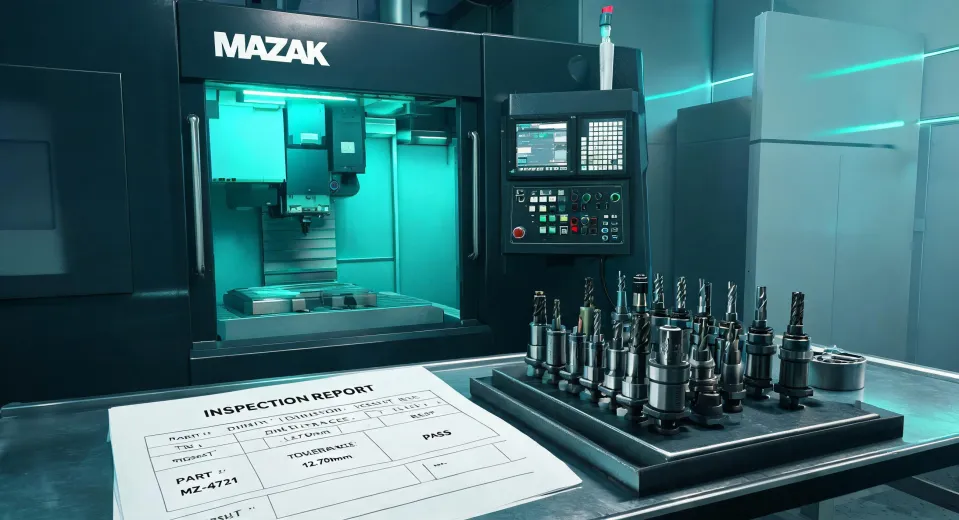
Run those numbers on a budget machine versus a well-built machine from a brand like Mazak, and you'll see the real difference. Mazak CNC mills cost more upfront — no one's debating that. But the machines hold their tolerances for decades, the support network is solid, and the maintenance history is predictable. The cost per good part over the machine's life is usually lower.
Honestly, I'm not sure why so many smart people keep making the same mistake. Maybe because the price tag is the only number that comes with a guarantee. But I know it keeps happening.
Maintenance Is the Tax You Either Pay Now or Pay More for Later
This is the argument that always gets pushback, because maintenance is a boring and easy-to-defer expense. But I can count on one hand the number of emergency calls I've taken from a shop that had a current maintenance schedule.
Mazak CNC machine maintenance is a perfect example. These machines are built to run for decades, but they need regular attention: lubrication, spindle checks, coolant system maintenance, way cover inspection, calibration verification. A comprehensive maintenance contract on a machining center runs about three percent of the purchase price per year. On a $150,000 machine, that's maybe $4,000 a year.
Sounds like a lot — until you realize a single spindle failure is a $30,000 to $60,000 event. One unplanned failure eats ten years of maintenance costs. I've watched more shops than I can count lose that bet.
My own company made the same mistake in 2023. We canceled the maintenance contract on one of our Mazak lathes to trim costs. Six months later, the shot pin failed and the turret collided with the chuck. $47,000 in repairs and eleven days of downtime. We lost a major customer's next three orders to a competitor.
Here's the counter-intuitive part: a well-maintained old machine will outperform a neglected newer machine every single time. I've seen a 15-year-old Mazak machining center hold +/-5 microns all day, while a two-year-old budget machine from an unnamed brand drifts three times that between warmups. Age doesn't matter. Maintenance does.
Monitoring and Data Catch Problems Before They Become Emergencies
I used to think predictive monitoring was a nice-to-have for big companies with big budgets. I was wrong.
After that spindle failure, we added vibration sensors to all our critical machines. Cost: $800 per sensor. Two months later, one of those sensors on a Mazak machining center showed early bearing wear — enough notice that we scheduled the spindle swap during a planned holiday shutdown. No emergency. No rush shipping. No lost days. That $800 sensor saved us from what would have been a $60,000 failure.
The same logic applies to production monitoring in injection molding. Molding machines run 24/7, and without process monitoring, you don't notice when cycle times drift or melt temperatures wander. Those slow, gradual shifts can ruin thousands of parts before anyone catches them. A basic monitoring system catches the drift early, costs a few thousand dollars, and pays for itself in scrap reduction within months.
I see the exact same pattern in 3D printing. Whenever someone asks me what causes spaghetti in 3D printing — the print turning into a mess of filament strings — I tell them it's almost always poor bed adhesion, wrong z-offset, or wet filament. All fixable. All preventable. But people buy the cheapest printer, skip the calibration, then wonder why their prints fail. It's the miniaturized version of the same $350,000 disaster.
The "I Can't Afford the Better Machine" Objection
I can hear the objection already: "Easy for you to say. Not everyone has Mazak money."
Fair. I've been there. But TCO thinking matters even more when your budget is tight. If you're capital-constrained, you can't afford expensive failures — and you especially can't afford a machine that sits down for three weeks waiting on parts.
When budget is limited, the smart play is usually a used machine from a top-tier brand rather than a new machine from a budget brand. A well-maintained used Mazak with 8,000 hours will beat a new economy machine on accuracy, reliability, and resale value. I've owned both. I know which one made my life easier.
This applies to smaller purchases too. I've seen shops compare an Accurl press brake price or similar import-brand sheet metal machinery against a premium option and assume the cheaper one is good enough. Maybe it is. Maybe it isn't. But if you're running tight-tolerance bending, or the machine sits in a production line where downtime is expensive, the math changes quickly. Nobody calculates what a missed delivery date costs until it's already costing them.
Stop Shopping with Your Eyes Closed
I know I've been blunt. I've watched too many shops make the same mistake to soften the message.
The value of guaranteed turnaround isn't speed — it's certainty. When a client knows their deadline will be met, that confidence is worth more than any discount off a machine's price tag. Last quarter alone, we processed 47 rush orders with 95 percent on-time delivery. That's not because we're the cheapest shop in town. It's because we have machines we can trust, maintenance that actually gets done, and monitoring that flags problems while there's still time to act.
Buy the right machine. Maintain it. Watch the data. Calculate the total cost.
Or keep buying on price tag alone — and save me a seat for the phone call.