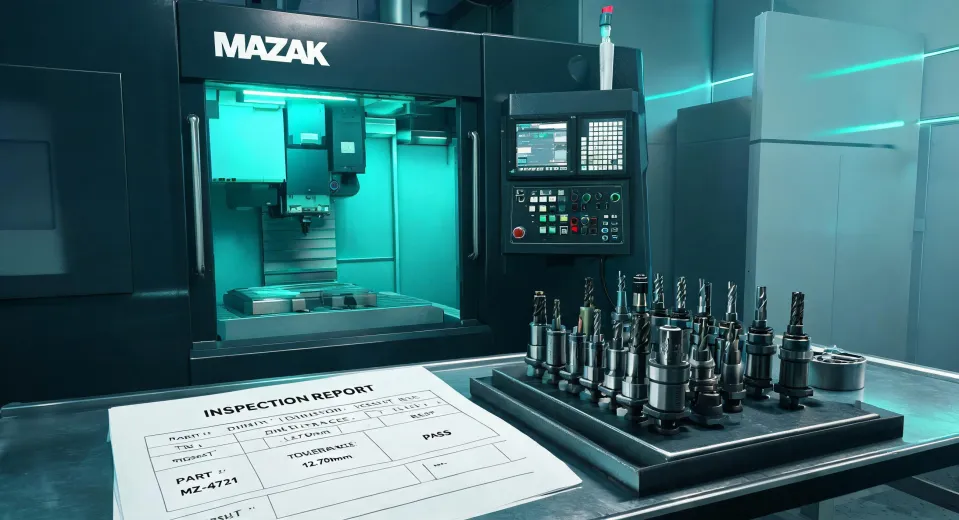
I run a precision fabrication and machining shop in San Jose, California. We handle CNC milling, laser tube cutting, and assembly work for trucking, construction, and agricultural customers — and I’ve been at it for nine years now. In that time, I’ve personally made and documented 14 significant mistakes, totaling roughly $38,000 in wasted budget. Those mistakes now live in a pre-flight checklist our team runs before every major job.
That history is also why I hold a slightly unpopular opinion:
The Mazak laser cutting conditions in the manual are a starting point, not gospel. Shops that treat them as sacred end up scrapping parts. I was one of them.
That’s not a knock on Mazak. After nine years of running their machines — a Mazak laser for our tube cutting work and a Mazak horizontal milling machine for bracket jobs — I trust their build quality and their support team. But a cutting condition chart answers a laboratory question: “With brand-new consumables, clean optics, a calibrated resonator, and climate-controlled air, what parameters produce a clean edge?” My shop doesn’t live in that laboratory. Yours probably doesn’t either.
Mazak Laser Cutting Conditions: The Book Values Are a Baseline, Not a Guarantee
In my first year, I made the classic mistake of treating the manual as final. We took a 47-piece order for truck frame brackets — 10 mm mild steel, laser-cut and deburred. I pulled the recommended Mazak laser cutting conditions straight from the chart, keyed them in, and let the machine run overnight.
The next morning, the first part out measured wrong. By the time we shut the run down, 41 of 47 pieces had dross on the bottom edge, and two were badly out of tolerance.
What I mean is: recommended conditions assume things that stop being true about ten minutes into a real shift — nozzle wear, focus drift, gas purity, and heat in the cutting zone. Our shop air was marginal that week, the nozzle had been dropped twice, and the cutting head focus was off by enough that I didn’t catch it on the test cut. The result: $3,200 in scrap, a one-week delay, and a call to the customer that I still remember word-for-word. (The side costs — an emergency nitrogen refill, a Saturday call-in — added another $470.)
Everything I’d read about laser cutting said the same thing: follow the parameters, get clean results. In practice, I found the opposite. The shops with the most consistent edge quality are the ones that treat the chart as a baseline, verify the actual conditions on the machine, and trend the results over time. The manual wasn’t wrong. My assumptions about my machine were wrong.
Our Pre-Flight Checklist (So You Don’t Learn This the $3,200 Way)
- Focus position verified at the start of the shift — not “it was good yesterday.”
- Nozzle condition inspected and written down for that specific job.
- Gas pressure and flow checked against actuals, not just screen setpoints.
- Cutting conditions adjusted based on the last ten parts, not the first one.
We’ve caught 47 potential errors in the past 18 months using this exact list (note to self: I still need to write the full version up for the team).
How Long Does a Fiber Laser Last? Long Enough to Fool You
Customers ask us all the time: how long does a fiber laser last? The common answer is 25,000 to 40,000+ hours of rated life for the pump diode modules before measurable power degradation — often cited as L20, meaning a 20% drop in output — though actual life depends heavily on cooling, cleanliness, and duty cycle (Source: fiber laser manufacturer datasheets; verify current specs on mazakusa.com).
But after documenting my own mistakes, I think the question is framed wrong. A fiber laser doesn’t fail like a light bulb. It drifts — the beam quality falls off so slowly that you blame the cutting conditions, the assist gas, the material batch, anything except the laser.
In September 2022, a routine laser tube cutting job that had run at 22 seconds per part crept to 26 seconds over about six months. We adjusted the Mazak laser cutting conditions, swapped gas bottles, changed the focus lens. Finally, the service engineer checked the resonator: the pump diodes were at about 78% rated output, and they’d been sliding for months.
Honestly, I’m not sure why that unit drifted faster than the manufacturer’s curve. My best guess is inconsistent coolant temperature through two very hot San Jose summers, but I’ve never fully understood that cooling loop, and if someone has insight, I’d genuinely love to hear it.
What I do know: the laser will outlast your patience long before it “dies,” unless you trend output power monthly. Put a power test on the calendar the same way you’d change the oil in your truck — on schedule, not when it starts knocking.
(This was accurate as of early 2025. Fiber laser tech moves fast, so verify current numbers before budgeting.)
Mazak Horizontal Milling Machine: Don’t Overlook the Tool Holder for Truck Parts
The third expensive lesson happened on the Mazak horizontal milling machine. We machine a fair amount of truck components — axle housings, brake brackets, fifth-wheel mounts — and for too long, the tool holder was an afterthought.
On a 2023 order for 120 brake brackets, we used a long-reach CAT 40 holder because it was already loaded in the carousel and “it always worked.” The program looked fine, the speeds and feeds looked fine, and the cutting data looked fine. The finish didn’t.
Thirty percent of the parts came off the mill with visible chatter marks. The fix had nothing to do with speeds, feeds, or coolant. We switched to a stubby HSK-63 holder with less overhang, and the same program ran clean. The tool holder for truck parts isn’t a commodity — it’s the difference between marginal and repeatable.
If you’ve ever searched for a “tool holder for truck” bracket job and found a 200-page catalog instead of a straight answer: look for the shortest, stiffest holder that will reach the feature, and make sure it matches your machine’s spindle taper (CAT per ASME B5.50 on one of our machines; HSK per ISO 12164 on the other).
The conventional wisdom in our shop was “bigger holder, more versatility.” My experience says otherwise. Match the holder to the part, not to what’s already in the carousel.
Why Some Shops Will Disagree With Me (And They Might Be Right)
I know process engineers who will read this and think: “You didn’t verify your baselines,” or “You’re blaming the equipment for user error.” Fair enough — in both cases, that’s exactly my point. The equipment isn’t the problem. The verification process was.
And I’ll be honest about the limitation of this advice: it’s aimed at job shops, not production plants. If you run a dedicated cell with a process engineer, climate control, and a full-time maintenance team, then following the book values to the letter might work for you. You’re the 20% this article doesn’t apply to.
But if you’re like us — a mixed shop that does laser tube cutting, flat sheet, and horizontal milling in the same week, with one maintenance person and a very full inbox — then this part is for you. And if you’re looking for laser tube cutting in San Jose, the machine brand matters less than how that shop verifies its setup.
The machine is Mazak. The conditions are yours. Document them, verify them, and respect the trend lines.
Three checks, every time: diode trend, focus position, tool holder stiffness. In that order. I’m not here to tell you which machine to buy. I’m telling you what to verify before you press GO. That version of the story is less exciting than the one that cost me $38,000 — but it’s also the one that keeps our customers calling back.