Earlier this month, a small shop owner sent me a spreadsheet that actually hurt to read. Not because it was badly formatted—it was tidy—but because I could see precisely which line item was about to eat his budget.
He'd placed three things side by side:
- A Bambu Lab printer that he'd labeled as his future “metal 3D printer.”
- A consumer laser cutter he planned to use for “small sheet metal” work.
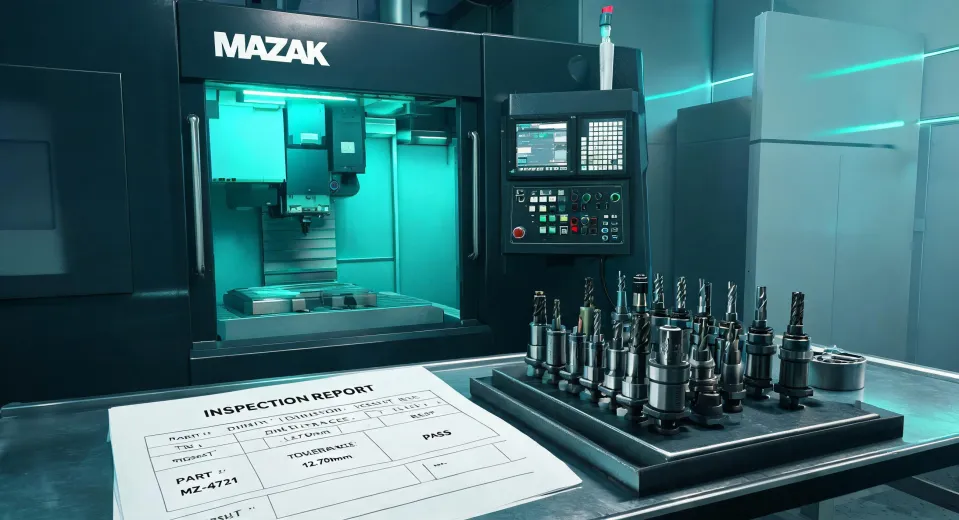
- A quote from a Mazak distributor for a VCN-class vertical machining center.
The numbers were roughly $1,500, about $5,000, and well over $100,000. His question was short:
“I'm not saying the Mazak is bad. But is it 25 times better? Where does our budget actually go?”
I knew exactly how he'd gotten there. When you run a small shop, every piece of equipment looks like it sits on the same ladder. A desktop printer makes parts. A laser cutter makes parts. A giant CNC machine also makes parts. So you line up the prices and try to find the “best value.”
That comparison is the problem. Not the machines. Not even the budget. The comparison itself.
Sticker Prices Are the Least Useful Number on the Spreadsheet
The surface issue is that price tags look like they carry the same kind of information across equipment categories. They don't. If you've ever typed “mazak cnc machine price” into a search engine, you probably noticed that the most useful result is a request-a-quote button. That's not a marketing trick. A Mazak VCN machining center can be configured so many ways—spindle speed, table size, pallet system, probing, tool breakage detection, coolant through spindle, software integrations—that a single “price” would be meaningless.
By contrast, consumer equipment is sold like a phone. One model, one spec, one price. That makes desktop machines feel more transparent. But the transparency is an illusion—the fine print is just hidden in consumables, material trials, maintenance, and your own labor.
I've spent six years managing procurement for a 38-person contract manufacturing company. We track every order, every tool, and every hour that touches a part in our cost system. After a few years of that, you stop asking “what does the machine cost?” and start asking “what does the finished good actually cost?” Those are two completely different numbers.
“Metal 3D Printer” Means Three Completely Different Things
Let's start with the phrase causing half of this confusion: “metal 3D printer.”
If you search for “bambu lab metal 3d printer,” you're likely to find desktop machines that can print metal-filled filament. These are real, capable printers—but they print a “green” part: metal powder held together by plastic binder. After printing, you need to chemically debind the part, then sinter it in a furnace. Sintering shrinks the part, and the shrinkage is rarely perfectly even. That's not a hidden flaw; it's a material property. But it means the machine itself is only one-third of the pipeline.
Under the ISO/ASTM 52900 additive manufacturing standard, that process is classified differently from, say, powder bed fusion, where a laser melts metal powder directly. Calling every machine that can touch metal powder a “metal 3D printer” is like calling a forklift a “car because both have wheels.” The categories exist for a reason.
In my opinion, that distinction matters more than most buyers realize. A desktop printer that extrudes metal-filled filament is a brilliant tool for prototyping a metal-like part. But it is not a substitute for a production metal printing system, and it's definitely not competing with a CNC machining center.
The Real Divide: Iteration vs. Production
The deeper cause of the confusion is that we compare machines before we define the workflow.
Consumer tools are iteration machines. A “best consumer laser cutter” is excellent for cutting acrylic, wood, and thin materials quickly while you're still designing. It is not a sheet metal production line. Bambu Lab and similar printers are superb for rapid prototyping, print-in-place mechanisms, and low-volume plastic parts. They are not repeatable production systems for aerospace-grade metal components.
A Mazak CNC machining center is a different species entirely. It's designed to run the same program on the same material thousands of times while holding the same tolerance. It's an industrial production platform. That's why the “cnc mazak” search is usually done by someone who already has a production requirement, not by someone exploring whether they can make a part at all.
And that's the real divide: iteration and production are different budgets.
Iteration machines make mistakes affordable and learning fast. Production machines make repeatability affordable and mistakes expensive. When you compare them by sticker price, you're ignoring the single most important variable: what the part is for.
What the Confusion Actually Costs
Here's where the money disappears. Not in the purchase. In the attempts.
A few years ago, I watched a client try to use a desktop metal-filled printing workflow for a small batch of stainless steel brackets. The first printed sample looked fantastic. Then came the sintering trials. The holes were oval. The flat surface had warped slightly. The second attempt fixed the holes but introduced cracking around a thin wall. After three weeks of iterations and roughly $1,200 in material, failed runs, and used furnace time, they sent the drawing to a local machine shop. The shop ran the brackets on a Mazak VMC and delivered good parts in four days.
The desktop printer wasn't bad equipment. The workflow was simply the wrong category for a production order. That mistake cost far more than the printer itself.
I've seen the same pattern with consumer laser cutters. They're unmatched for quick iterations on enclosures and panels. But when someone tries to use one for repeatable small-batch metal production, they discover that thermal drift, air assist, and material variation all eat into yield. Then the scrap rate turns the “cheap” machine into the most expensive option in the room.
That's not an equipment flaw. It's an expectations flaw.
One more detail from that spreadsheet stuck with me. In a separate tab, the owner had written: “what is metal grease for 3d printer?” He was already asking about maintenance. I've never fully understood why that question is so rare in equipment shopping—lubrication is where the small failures hide. A $30 tube of grease is nothing. A seized linear rail because the wrong grease was used is a $600 repair plus a week of downtime. If you aren't budgeting for the support systems around a machine, you aren't budgeting for the machine.
How I'd Spend That Budget Now
Here's the uncomfortable answer I gave that shop owner: I'd start by not buying a Mazak. Not yet.
I'd first define the actual production requirement. What material? What tolerance? What annual volume? How many design revisions per month? The answers change everything.
If the goal is prototyping and product development, a Bambu Lab printer or a good consumer laser cutter can absolutely be the right purchase. They're iteration machines, and that's a legitimate role. The mistake is expecting them to carry production loads.
If the goal is production of metal parts with tight tolerances, the industrial route—whether that's outsourcing to a well-equipped machine shop or eventually investing in your own Mazak machining center—will win on cost per good part almost every time. Even the high-end consumer and prosumer machines can't match the spindle rigidity, thermal stability, tooling options, and automation of a real CNC platform.
But here's the part I try to tell every small buyer: calculate cost per good part, not cost per machine.
Include consumables, tooling, setup time, programmer time, maintenance, floor space, and scrap in the math. If a desktop printer costs $1,500 but burns three weeks of your time and still can't hold the tolerance, it was never cheap. If a Mazak quote looks impossible this year, then outsource to a shop that already runs one and track the actual piece price. That data will tell you when the machine justifies itself.
And if you're worried about being a small customer, don't be. The suppliers who treat a $2,000 order seriously today are the ones who earn the $200,000 order two years from now. Small doesn't mean unimportant—it means potential.
The Bottom Line
The owner with the spreadsheet didn't buy a machining center. He bought three weeks of a good CNC programmer's time, outsourced his first production runs to a local shop that runs Mazaks, and started tracking real cost per part.
The Mazak quote is still on his spreadsheet, but now it has a date and a payback calculation attached to it. The desktop printer is still on his list too—as a prototyping tool, not a production line.
That's the shift that saves money: stop comparing price tags and start comparing workflows. A Mazak isn't 25 times better than a consumer printer. It's a completely different category of solution. Once you know which category your part actually belongs to, the budget question answers itself.