-
The Comparison Framework: Buy the Machine vs. Rent the Factory
-
Dimension 1: Mazak CNC Mill Cost vs. Per-Part Factory Cost
- Dimension 2: Lead Time — When the Deadline Is a Bomb
-
Dimension 3: Quality Control — Who Catches the Problem First?
- The Dimension Nobody Expects: Sometimes Both Options Are Wrong
-
The Verdict, by Scenario
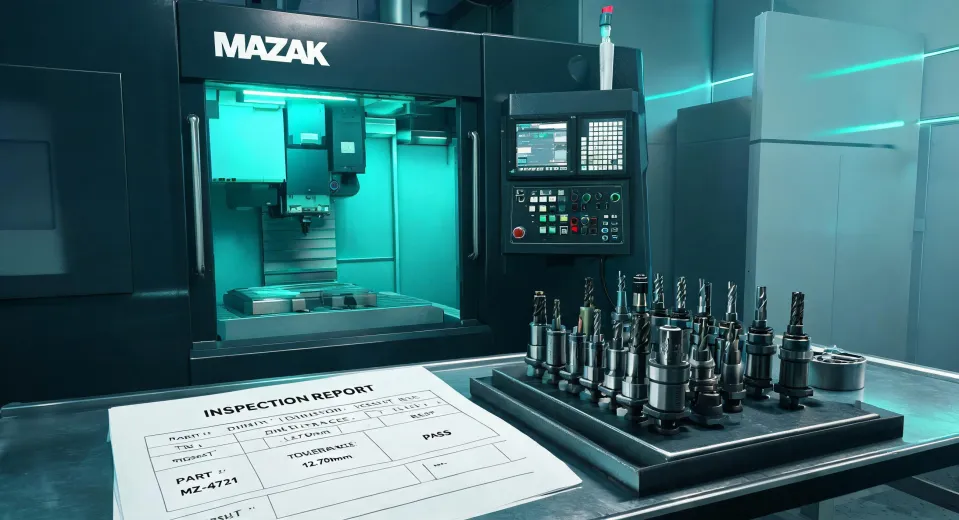
In my role coordinating production for a contract machine shop, I keep two kinds of quotes coming across my desk. One says “buy the Mazak.” The other says “send the CAD file to a China precision CNC machining parts factory.” I've handled 200+ rush orders in eight years, including same-day turnarounds for aerospace and medical device clients, so this isn't a comparison from a brochure. It's the framework I actually use when a deadline is hanging over my head.
Let me be upfront about my bias: I think small orders deserve the same care as big ones. Today's $300 prototype is next year's $30,000 production run, and I've seen suppliers lose long-term customers simply because they couldn't be bothered with a small first order. That belief shapes how I compare options. But it doesn't make the decision fuzzy. Here's how I break it down.
The Comparison Framework: Buy the Machine vs. Rent the Factory
The question I'm really trying to answer is simple: do I need a Mazak in my own building, or do I need someone else's Mazak 7,000 miles away? Those are not the same decision, and the difference matters most when you're in a panic.
I judge every option on four things:
- Cost: not just the machine price or the unit price, but total cost over a year
- Lead time: what actually happens when I need parts in days, not weeks
- Quality control: who notices a problem first, and how hard is it to fix?
- Fit: is a full CNC machine even the right tool, or am I overcomplicating it?
Dimension 1: Mazak CNC Mill Cost vs. Per-Part Factory Cost
Let's get the obvious number out of the way. A new Mazak vertical machining center — something like a VCN model — starts around $130,000 to $250,000 depending on the table size and options. Maybe $148,000. No, wait, I'm mixing that up with the base config I priced in late 2024. Point is, five figures is rare, six figures is normal, and that's before you add tooling, workholding, a rotary axis, and the floor space.
When I first started comparing in-house machining to outsourcing, I assumed the purchase price was the whole story. Three budget overruns later, I realized the machine payment is just the entry ticket. You still need someone to run it. You need coolant, vises, end mills, probing cycles, and the occasional $400 service call from a technician who can't come for two weeks. (Should mention: Mazak machines are generally reliable, but any CNC machine will eventually need attention. I've had far fewer surprises with Mazak than with budget brands, but I don't want to pretend maintenance isn't a line item.)
Now compare that to a China precision CNC machining parts factory. For a 124-piece aluminum bracket order I sourced last March, the factory quote was $420. To be fair, that's a genuinely good price — I've seen US job shops quote $1,100 for the same work. But the $420 never stays $420. Add sea freight, customs clearance, and the bank transfer fee, and you're at $520 if you can wait a month. Add air freight, and suddenly it's $680. The factory isn't ripping you off. The distance is.
The lowest quoted price is often the most expensive number on the invoice once logistics, delays, and rework are added to it.
Dimension 2: Lead Time — When the Deadline Is a Bomb
In March 2024, a client called at 3:40 PM needing 124 aluminum brackets delivered for a trade show demonstration. They needed parts in hand 36 hours later. Their normal vendor had quoted them a 4-week lead time. I could hear the panic in their voice. Missing that deadline would have triggered a $50,000 penalty clause in their own customer contract.
Let me put the two options side by side in a real timeline:
Option A: The China precision machining parts factory
The factory I use can do production in about 10 days when expedited, then air freight takes 4 to 7 days depending on customs clearance. That's two weeks minimum. Best case scenario: 12 days. That was never going to work.
Option B: The Mazak on my shop floor
We programmed the part in about 90 minutes, dialed in the fixture, and started cutting chips that same evening. The machine ran through the night. By 6:30 AM, we had all 124 parts deburred, inspected, and packed. The client paid a $190 rush fee on top of our base price, and they got their brackets before their own suppliers had even replied to their email. Oh, and the alternative wasn't just an inconvenience — it was a lost $50,000 contract. That was the moment I stopped treating the Mazak as an expensive line item and started treating it as an insurance policy.
That story isn't meant to scare you away from outsourcing. It's meant to show you that lead time is the hidden cost of every overseas quote. If your product design is frozen and your demand is predictable, those six weeks of sea freight probably won't hurt you. But if your customers change their minds a lot, or if a machine down at their plant means they need replacement parts now, an ocean between you and your supplier becomes a threat.
Dimension 3: Quality Control — Who Catches the Problem First?
Quality is the dimension where people expect me to say Mazak always wins. It doesn't — not by default.
A good China precision CNC machining parts factory with modern equipment can hold tolerances as tight as most US shops. I've inspected parts from a 5-axis Mazak in Shanghai that were indistinguishable from parts made on a 5-axis Mazak in Kentucky. The difference is not the machine; it's the communication loop.
When parts are made 20 feet away from me, I can walk over, grab a micrometer, and check the first article myself. If the surface finish isn't right, I change the feed rate over lunch and have a new part by 2 PM.
When parts are made 7,000 miles away, a simple drawing revision becomes a 24-hour email loop — and that's if the factory is responsive. I've had factories interpret “critical dimension” differently than I intended, and the first sign of trouble was a photo of 200 scrapped parts. In my experience, this isn't about the factory being careless. It's about the asymmetry of feedback. They can't see my client's face when I tell them the delivery will slip.
There's a second quality factor that surprises people: machine ownership gives you institutional memory. When I cut aluminum on my own Mazak every day, I know exactly how it behaves — how it sounds in a heavy cut, how much tool deflection to expect, which materials make it squeal. That's not quality data you can send over email. It's knowledge that lives in your hands.
The Dimension Nobody Expects: Sometimes Both Options Are Wrong
Now let me complicate the answer. Not every part worth making needs a Mazak. In my rush-order career, I've learned to ask a harder question: “Do I need a machining center at all, or do I need a toy?”
I'm being serious. Two of the five search terms that led a client to my website were “machining aluminum with CNC router” and “can I create my own costume on 3D printers?” Those sound like beginner questions. But they're actually the right questions for a certain category of project.
Machining Aluminum With a CNC Router
If you're making one-off aluminum parts that don't need tight tolerances — say, a bracket for a custom bike or a mounting plate for a hobby project — a CNC router with a decent spindle can absolutely machine aluminum. You'll need shallow cuts, slower feed rates, and plenty of coolant or mist, but it works. I've used a router to prototype a thin aluminum cover in two hours while waiting for a quote from three machine shops. Was it pretty? No. Did it function well enough to test the design? Yes.
The place where a CNC router falls apart is precision. A router is built for speed and large sheets of soft material, not for holding ±0.005-inch tolerances on bearing fits. If a part needs to mate with something machined to exact dimensions, a router is not your answer. But if you framed the question as “I just need to know if this will work before I spend real money on real manufacturing,” a router might be the smartest tool you own.
“Can I Create My Own Costume on 3D Printers?”
Yes. Absolutely, yes. I have printed helmet pieces, armor panels, and wearable props on a $400 FDM 3D printer. For custom costumes, a 3D printer is not a compromise — it's the correct production method.
Why would I send a 3D model of a costume piece to a China precision CNC machining parts factory? The factory would either laugh me off or quote me a stupid price, because machining a costume from solid material is wasteful. Nobody needs the dimensional accuracy of a Mazak for a belt buckle. Nobody needs the minimum order quantity of an overseas production run for a one-piece cosplay item.
Choosing the right tool means respecting the part's real requirements. A precision bracket belongs on a Mazak. A costume prop belongs on a printer. Mistaking one for the other is the most expensive mistake in manufacturing.
The Verdict, by Scenario
So which should you choose? My answer depends entirely on your situation.
Buy a Mazak machine if:
- You machine parts every week, not once a season
- Your tolerances are tight enough that you need hands-on control
- Your customers expect turnaround measured in days, not weeks
- You want parts to be your “insurance policy” against supply chain chaos
Use a China precision CNC machining parts factory if:
- Your designs are stable and volume makes overseas shipping economical
- You're a smaller company with limited capital — buying a Mazak isn't always possible, and that's okay. A good factory doesn't treat a $500 order like a nuisance. And when I find a factory that respects my small orders, I return with bigger ones. Small clients deserve good service.
- You're willing to keep 4–6 weeks of inventory buffer
Reach for a CNC router or 3D printer if:
- You're prototyping, whether it's aluminum on a router or a custom costume on a 3D printer
- The part doesn't require tight tolerances or high structural load
- You need something today, and “today” is more important than “perfect”
As I recorded this, I realized I've made every mistake this article warns about. I've outsourced deadline-critical parts, bought cheap routers for precision work, and 3D-printed things that should have been machined. Eventually, I built a process that starts with the part's real requirements and works backwards.
In my opinion, the strongest move for most small-to-medium companies is not choosing one option forever. It's owning a Mazak, cultivating relationships with overseas precision factories, and keeping a humble router and printer in the corner for the jobs that don't need a hero machine. Each tool has a job. The art is knowing which job is in front of you.