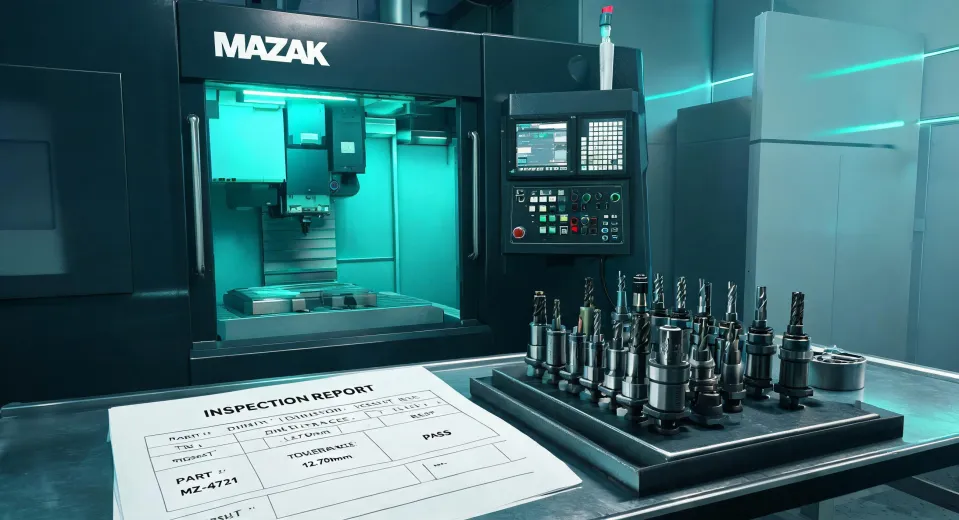
In December 2024, a client call changed the way I think about Mazak, 3D printing, and the word "fast."
I coordinate production at a job shop in the Midwest. We run mostly Mazak equipment: CNC lathes, vertical mills, and a Mazak laser cutter. I've handled 200+ rush orders in 8 years, including same-day turnarounds for medical device clients. So when a long-time customer called on a Thursday afternoon, my first emotion was not panic. It was "I need to find capacity."
Here's what happened.
Monday Morning Would Cost $15,000
The request sounded simple: 12 aluminum housings by Monday morning for a live demo at a defense trade show. Normal lead time is twelve working days. If we missed the deadline, the contract had a $15,000 penalty clause. We had the aluminum bar stock in-house, but all three of our Mazak lathes were loaded with other jobs. Mazak's SmartFactory software showed me in real time that I had zero spindle hours available that week.
When I first started doing rush orders, I assumed the fastest quote was the best quote. That assumption cost us a $40,000 contract in 2023, not because the part was bad, but because our vendor overpromised and delivered a day late. Since then, I triage every emergency by three things: timeline, material, and risk. This time, I pulled three quotes.
I made a triage sheet the old-fashioned way: 12 pieces, 72 hours, 6061-T6 aluminum, +/-0.05 mm tolerance. That sheet eliminated a lot of options. If you can't hold the tolerance, it doesn't matter how fast you are. Additive wasn't ideal for the threaded inserts, but it was worth a call.
Option 1: A 3D Printing Service in USA
I called a 3D printing service in USA that boasted a 1-day lead time. The salesperson quoted $1,900 for 12 sintered nylon parts, delivered Monday morning. Based on the vendor's online quote, December 2024; verify current pricing. For a purely cosmetic booth display, they would have been perfect.
But these housings needed threaded inserts, and the assembly would sit near a heated component that reached about 80°C. Nylon would soften and warp. I asked the owner on the phone, "Can this part handle that heat?" He paused for a moment and said, "Honestly? Not this material."
That honesty was worth more than the quote. It also answered a question I hear a lot: how do I start a 3D printing business? You start by being honest about what additive manufacturing can and cannot do. If you try to print every part, you'll lose the jobs that need real metal. If you tell people when their part should be machined instead, they'll trust you.
Option 2: China CNC Milling Prototype
Next, I contacted a shop in Shenzhen that had sent us impressive prototype work before. Their China CNC milling prototype quote came back at $740 including air freight — less than half the 3D printing quote. But the delivery date was seven working days. Even with expedited shipping, it could not land by Monday.
Cheap and fast are not the same thing. I'm not 100% sure how the math would have looked with a freight forwarder, but it didn't matter. A China CNC milling prototype shop can be a fantastic partner when you have ten days and a tight budget. For a 72-hour emergency, geography is your enemy.
Option 3: A Used Mazak Lathe for Sale
By Friday morning, I had one serious lead. A dealer in the next state had a used Mazak lathe for sale — a 2016 model with a live tool turret and a bar feeder. The dealer was willing to run our parts Friday night for a rush fee. Their machinist had worked on Mazak controls for 20 years, and according to the dealer's maintenance log, the spindle had only 4,200 hours. It felt kinda like finding a unicorn.
The dealer let us watch setup over a video call. We saw the bar feeder load, and I recognized the same Mazak control screen from our own shop. That visual confirmation mattered more than any contract.
The base cost for the machine time was $850. With the rush fee, setup, and material handling, the total came to $2,050. We paid an extra $1,200. That was the easiest $1,200 I've ever spent. The alternative was a $15,000 penalty, a lost account, and a very bad Monday.
The parts were finished by 6 a.m. Saturday (finally!). Meanwhile, our taglio laser Mazak — forgive my Italian; that's "Mazak laser cutting" — cut 3mm steel fixture plates in about twenty minutes. Two of our mill guys did the secondary work on Saturday afternoon. Final inspection, packing, and shipping all went out by Sunday evening. Monday morning, the parts hit the demo table.
What the Comparison Taught Me
When I compared the three quotes side by side, I finally understood why "best" is a dangerous word. The 3D printing service in USA was fast but wrong material. The China CNC milling prototype was cheap but wrong timing. The used Mazak lathe was neither the cheapest nor the most exotic. It was the only option that matched the deadline, the material, and the risk profile.
Here are the lessons I keep going back to:
- If your part is a cosmetic prototype with no mechanical load, a 3D printing service in USA can be the right call. But ask about material properties before you get excited about the lead time.
- If you have a two-week window and a low budget, a China CNC milling prototype shop is worth a serious look. Just add three days to whatever they tell you.
- If you need metal parts in under 72 hours, try to find a machine shop with a Mazak lathe — new or used — and be willing to pay the rush premium. It's almost always cheaper than the penalty.
I don't have hard data on every used Mazak lathe for sale in the country. What I can say anecdotally is that this one worked because the dealer had records, the machinist knew the control, and we could send a program that matched our own Mazak postprocessor. It was not luck; it was verification.
The Part Nobody Sees
The part nobody sees is the coordination. Between Friday afternoon and Sunday night, I sent 47 emails and took 13 phone calls. The dealer needed a copy of our 3D model, a material cert, and a signed PO. Our client needed a shipping label, an inspection report, and a promise that someone would be at the loading dock at 6 a.m. That side of a rush job is rarely discussed, but it decides who survives.
I also learned that honesty is the best filter. The 3D printing owner who said "not this material" did more for his credibility than a glossy brochure ever could. And that is exactly what I tell anyone who asks how do I start a 3D printing business? Build your business on knowing what not to make.
Final Thought
Our company now has a 48-hour buffer policy on every large order. We implemented it after the 2023 failure, and it saved us again here. The buffer did not prevent the emergency; it gave us room to survive it.
There is no universal best. There is only the right combination of time, material, cost, and risk. On that weekend, the right combination was a used Mazak lathe, a taglio laser Mazak, and a 3D printing quote that taught me when to say no.
If you're in a similar spot, start by asking what you can't compromise on. The date? The metal? The price? Then work backward. Honestly, that sequence will save you more agony than any machine choice.