-
Three scenarios, three different answers
-
The mistake that changed how I buy machines
-
Scenario 1: Round parts and continuous production
-
Scenario 2: Flat stock, sheet metal, and the real laser work
-
How to adjust the power on a laser cutter (the way I teach it)
-
Scenario 3: When the right answer isn’t a CNC machine
-
How to tell which scenario you’re in
-
The fundamentals haven’t changed, but the execution has
When I first started recommending machine tools, I thought the best equipment would reveal itself in the spec sheet. Horsepower, axis count, rapid traverse rates–I compared all of it. It took seven years and one embarrassing purchase to admit what I should have known from the beginning: there is no single best machine. There’s only the right process for the work in front of you.
I’m a manufacturing engineer in a job shop that handles short-run prototypes and production batches. I’ve signed off on roughly $2 million in equipment decisions–some good, one that still makes me cringe. This article isn’t a product catalog. It’s a set of scenarios I’ve learned the hard way.
Three scenarios, three different answers
The fastest way to choose a machine is to stop asking “What’s the best machine?” and start asking “What do my jobs actually need?” I group most of what arrives in our shop into three buckets:
- Round, symmetrical parts – shafts, bushings, fittings, pulleys. These belong on a CNC turning center.
- Flat or thin-wall parts – sheet metal brackets, acrylic panels, formed accents. These usually make more sense on a laser cutter.
- High-volume identical plastic components – housings, caps, enclosures. If you’re doing thousands per year, a two platen injection molding machine may beat any CNC process.
I know what you’re thinking: “But a five-axis mill can do all of that.” Yes, with enough setups, fixtures, and patience. The question is whether it can do those jobs profitably all week. That’s the question I failed to ask.
The mistake that changed how I buy machines
In 2019, I pushed my shop to add a five-axis machining center because “the industry was going multi-axis.” We didn’t have a single part that needed five-axis contouring for the next six months. We had bar-fed turning work. A Mazak CNC turning center with driven tooling would have done those jobs in about half the cycle time, and the budget would’ve let us add a bar feeder and tooling.
The realization came in the worst way. The machining center sat at 23% utilization while operators manually deburred turned parts from an older lathe. We bought a Mazak CNC turning center twelve months later, and it became the workhorse of the shop. The five-axis machine is still there, and I still look at the utilization report and feel the embarrassment. Maybe that’s why I keep a checklist now.
What did I learn? Match the process to the dominant geometry and batch size. A CNC turning center is not a compromise. It’s the correct answer when a large share of your parts have rotational symmetry.
Scenario 1: Round parts and continuous production
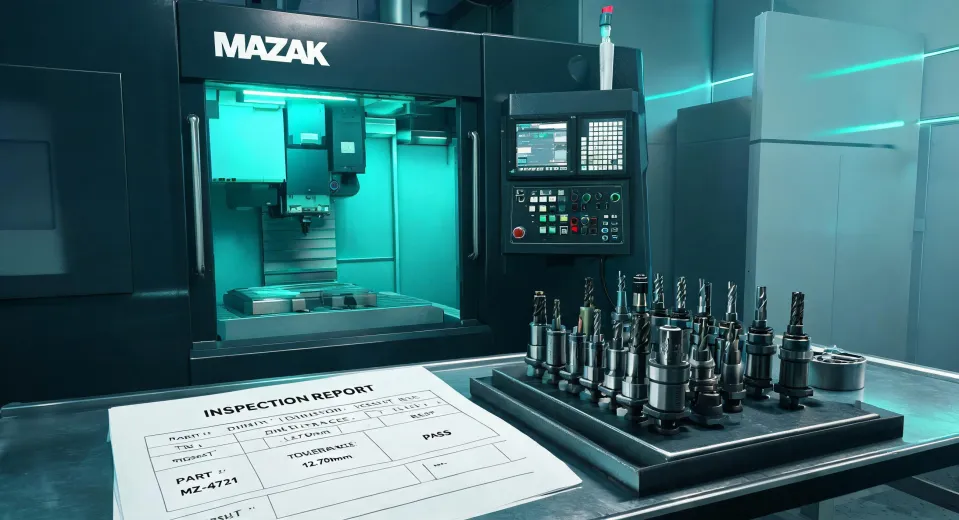
If more than 60–70% of your workpieces are round, I’d start every evaluation with a turning machine. For us, the Mazak CNC turning center with a bar feeder turned into a completely different operation. The machine runs without an operator in the room, and we check parts at the end of the shift. With the right monitoring software—we use Mazak’s SmartFactory for part of the shop, though not every cell is connected yet—we can catch alarms before they become scrap. Tolerances hold better than they ever did on the mill, because turning between centers has a rigidity that a machining center can’t always match.
A turning-centered process also handles second operations. With driven tooling, we can mill flats, drill cross holes, and turn threads in one setup. But here’s my usual warning: a turn-mill machine is not a small footprint miracle. You need to feed it with bar stock, keep the tooling organized, and trust the control enough to run unattended. The machine pays for itself only when the process is fed, loaded, and monitored.
Scenario 2: Flat stock, sheet metal, and the real laser work
Laser cutting is a different world. For sheet metal, thin stainless, acrylic, and wood, a laser cutter is hard to beat. I used to think a laser was just an expensive way to cut straight lines. Then I watched what happens when you get the focus and gas pressure right: the cut edge goes from rough to almost polished. The material looks treated, not just cut.
Let me also address the phrase directly: I’m using “treatment” to mean controlled beam processing, not a medical procedure. For manufacturers, the benefits of CO2 laser treatment go beyond cutting speed. On non-metallic materials and coated metals, CO2 lasers create a narrow heat-affected zone, which means less discoloration and less edge char. The same laser that cuts acrylic can be dialed down to engrave or condition a surface for paint or adhesion. That dual-use flexibility matters more than people realize.
Here’s the part nobody puts on the marketing page: laser performance is only as good as its consumables. Early on, I tried to save a few hundred dollars with generic replacement optics for our CO2 machine. The fit was fine, but the beam quality shifted. We ended up replacing them twice before I ordered genuine Mazak laser parts. I still buy some aftermarket tooling, but optics and nozzles are not where I save money anymore.
How to adjust the power on a laser cutter (the way I teach it)
There’s a question I hear constantly: how do you adjust the power on a laser cutter? The honest answer: on a production laser, you don’t do it with a dial on the side of the machine. You set power in the controller as a percentage of the tube’s rated output, and you tune it with a test. For our Mazak laser, I use a calibration routine:
- Run a sample of the actual material, same batch and thickness.
- Cut a series of lines with increasing power settings, keeping speed constant.
- Check the bottom edge. If there’s dross underneath, power is too low or speed is too high. If the edge is yellow or charred, power is too high.
- Adjust in 5% increments. Wait–I almost wrote 2–3%. That’s too fine for a first pass. Use 5% as a starting point, then fine-tune after you see the first test.
This isn’t random guesswork. It’s a process. And before anyone adjusts a production laser, I point them to the manufacturer’s manual and the current ANSI Z136.1 laser safety standard. That is not optional.
Scenario 3: When the right answer isn’t a CNC machine
Here’s where I have to raise my own expertise limit: high-volume plastic parts. If you’re making thousands of identical plastic enclosures per year, a CNC machine or a laser cutter is usually the wrong answer. The right answer is often a two platen injection molding machine.
I’m not an injection molding specialist. I’ve been the customer, not the molder. But I have toured enough molding shops to see the difference in real time. A two platen injection molding machine uses a simpler clamping system than a toggle machine. The moving platen can travel the full open width, which gives better mold access and often reduces wear on guide pins. For large, deep parts, that full-stroke movement also helps with mold changes. In high-volume production, a two platen machine can deliver shorter dry-cycle times than older toggle designs—but cycle-time claims should be verified with the actual mold, not taken from marketing.
How to tell which scenario you’re in
Most people don’t need more technical comparison; they need a method. Here’s the method I’ve used since the 2019 embarrassment:
- Pull your last 30 work orders. Count how many were round parts, prismatic parts, and sheet-material parts. That’s your geometry ratio.
- Calculate the true annual quantity per part. A part that repeats 5,000 times a year is a different candidate than a one-off prototype.
- Look at the material. Sheet and thin-wall materials point to laser. Bar stock and cast round blanks point to turning. Plastic resins point toward injection molding.
- Check tolerance and finish. If your customer requires concentricity within 0.001 inch on every diameter, a turning center is the safer process. A laser gives precision in position, but it cannot guarantee the same cylindrical finish.
- Add people into the equation. Does your team have the operators to manage a laser’s gas supply, optics, and extraction? Do you have a CNC programmer who understands turret indexing? If not, the best machine on paper will fail on the floor.
A good technology is not automatically a good process. The wrong process—even with a great nameplate—will show up in scrap, setup, and idle time.
The fundamentals haven’t changed, but the execution has
In 2017, I was convinced that adding a five-axis machine would make us look future-proof. It didn’t. In 2020, I was equally skeptical about unattended operation because “we’ve always had someone standing at the machine.” Then we bought the Mazak CNC turning center with a bar feeder, and the team adjusted in two weeks. The industry has changed. What was best practice in 2020 may not apply in 2025. But the fundamentals haven’t: know your parts, know your volumes, and let the process drive the purchase.
My advice is to stop asking which brand is “best” and start asking which scenario your shop matched last quarter. If you’re still not sure, run the numbers. For round parts, look at a Mazak CNC turning center. For sheet and thin-wall work, look at a laser cutter and budget for genuine Mazak laser parts. For high-volume plastics, find a molding supplier who runs two platen injection molding machines. One of these will fit. Maybe more than one will show up in a mixed shop.
That’s not a bland “it depends” conclusion. It’s a decision tree. I started with the wrong branch in 2019. You don’t have to.