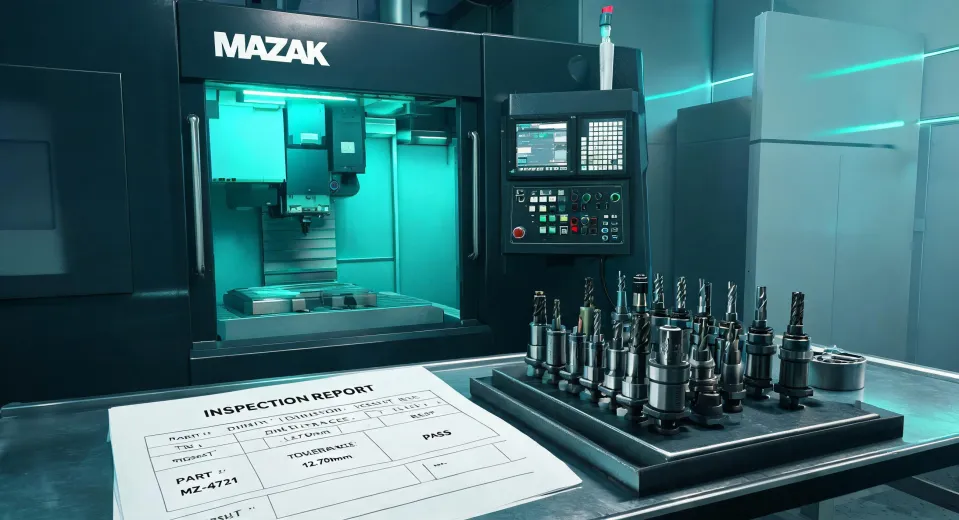
Six years ago I took over procurement for a small metalworking operation and made a classic mistake. I approved a machine purchase based on cost-per-hour math before checking how many hours the machine would actually run each week. We bought a new machining center, a large customer pushed their order out, and I spent six months watching that machine sit idle while the finance lease kept running. That's when I flipped my approach: production pattern first, machine second.
There is no universal answer to the question "Should I buy a Mazak?" Actually, there's not even a universal answer to "Should I buy a used Mazak cnc mill or send the work out?" The right decision depends on which of three production patterns describes your floor. If someone gives you one answer without asking about your work mix, they're probably selling you something.
Three production patterns, three very different answers
When I look at a shop's spending, I categorize its work by three patterns:
- Pattern 1: Low-volume, high-mix work — prototypes, repair parts, small batches, tight capital.
- Pattern 2: Repeat production — stable programs running two or three shifts.
- Pattern 3: High-precision or fabrication work — tight tolerances and laser processing where errors are expensive.
Each pattern leads to a different purchase decision. Let's walk through all three.
Pattern 1: Low volume, high mix, tight capital
If your shop runs mostly prototypes, repair jobs, and batches of one to five pieces, the utilization case for a brand-new machine is weak. From the outside, buying a machine looks like the way to reduce per-part cost. The reality is that a machine running only 10-15 hours per week carries its fixed costs like a dead weight. In this pattern, two options compete: a late-model used Mazak cnc mill and a relationship with custom CNC milling parts manufacturers.
Buying a used Mazak cnc mill: when it wins
A late-model used Mazak cnc mill can give a job shop real capability without the depreciation hit of new iron. I'm not talking about a worn-out relic. I'm talking about a vertical machining center built roughly between 2015 and 2019, ideally a 40-taper machine with documented spindle hours. Based on listings I tracked in late 2024, machines in that range commonly listed somewhere between $70,000 and $160,000 depending on condition and tooling. Verify current pricing before treating that range as gospel.
Used Mazak machines have one overlooked advantage for smaller shops: Mazatrol controls are approachable for operators who didn't grow up writing G-code. You're effectively buying lower training costs and faster setup for short-run work. There's also a strong installed base, which helps with both service availability and resale value later.
But you need to do the due diligence:
- Ask for spindle hours and service records. If the seller won't share them, treat that as a red flag.
- Set aside 5-10 percent of the purchase price for rigging, workholding, and first-year repairs.
- Confirm that local service technicians still support that machine generation. A cheap machine stops being cheap when the nearest technician has to fly in.
Here's something dealers don't put in listings: the hidden costs of a used machine usually show up in year two or three, not the first month. That's not a reason to avoid buying used. It's a reason to negotiate with a maintenance reserve in mind.
Why custom CNC milling parts manufacturers often win
The alternative is to keep your capital and route parts to custom CNC milling parts manufacturers. From the outside, outsourcing looks like an expense line on the P&L. What many people don't see is that outsourcing turns a fixed cost into a variable cost. Each order carries its full cost in the quote. When demand dips, you don't pay for idle spindles.
We didn't have a formal make-vs-buy review process once, and it cost us. We bought a machine based on one large customer's verbal commitment. The customer delayed, the machine arrived anyway, and we paid for floor space and finance charges while it sat. Now our policy is simple: if projected utilization is below roughly 20 hours per week, the purchase proposal must include an outsourcing alternative in the same review.
That said, I've also made the opposite call. In one decision, I went back and forth between a custom machine shop and a used Mazak for about two weeks. The outsource quote was lower on paper. I almost took it. Then I calculated the potential cost of one late delivery if the shop's "around the end of the month" slipped by a week. The possible penalty was larger than the savings. We bought the used Mazak. That's the time certainty principle: when a deadline matters, paying for control can be cheaper than paying for hope.
Pattern 2: Repeat production, two or three shifts
Now let's talk about a floor running the same programs over and over. In this pattern, utilization is high, and the dominant cost stops being the machine purchase. It becomes the cost of unplanned downtime and rejected parts during the night shift. The calculation flips.
A used machine might carry 10 percent higher unscheduled maintenance risk than a new one. On a three-shift week, 10 percent is nearly a full shift. No purchase discount makes up for losing a whole shift of output. This is where new Mazak machines and the Mazak iSMART Factory concept start making serious financial sense.
A cutting measurement tool is what makes overnight work possible
The most overlooked item in this type of purchase is the measurement loop. A cutting measurement tool — often called a tool probe — measures cutter geometry and wear while the tool is in the machine. Combined with a workpiece probe, it lets the machine compensate for variation before making parts instead of after scrapping them.
Here's the scenario that should drive your TCO analysis: a tool breaks at 1:00 a.m. on an unattended operation. Without a cutting measurement tool, the machine keeps running and produces scrap until the morning shift discovers the problem. With a tool probe, the machine detects the broken tool, stops, and alerts someone. The probe costs money; the overnight scrap pile costs more.
According to Mazak (mazak.com), iSMART Factory connects people, machines, and software to collect and use production data across the floor. That fits exactly with what a procurement person wants: fewer surprises. At a past employer, we added cutting measurement tools and basic machine monitoring to a three-machine cell. If I remember correctly, scrap dropped about 14 percent and spindle utilization rose about 9 percent over the first six months. I won't pretend every shop gets those exact numbers. But the direction was consistent.
Do you actually have processes mature enough for automation?
Here's the hesitation I share with owners who rush into smart factory investments: if your setups are chaotic, automating the chaos just produces scrap faster. The Mazak iSMART Factory payoff comes when you already have stable tooling, documented setups, and repeatable work. If you don't, fix the process first. Then let automation multiply the benefit.
Pattern 3: Precision parts, and the laser question
The third pattern is shops where the real business risk is tolerance, edge quality, or material behavior. Aerospace, medical, energy, and precision fabrication all fit here. In this pattern, the machine's physical capability is rarely your constraint. The constraint is controlling every variable around the cut.
Buy the measurement loop, not just the machine
If you machine expensive materials or parts with tight tolerances, do not spec a machine without including a cutting measurement tool in the package. The probe checks tool length, diameter, and wear before the tool engages the workpiece. It catches a worn insert before you lose tolerance on the first part of a batch, not after you've made thirty bad ones.
People often cut probes from the budget because they look like accessories. In precision work, they're not accessories. One scrapped titanium part or die section can cost more than the entire probing package. The question isn't whether the probe is affordable. The question is whether you can afford the alternative.
nd yag vs co2 laser: match the wavelength to the material
In the fabrication side of this pattern, I often get asked about laser choice. The question usually arrives exactly as typed in a search box: nd yag vs co2 laser. The short version is that laser wavelength must be absorbed by the material you're processing.
- Nd:YAG lasers operate around 1,064 nm and are absorbed well by metals. They're useful for metal marking, engraving, and certain precision cutting or welding jobs.
- CO2 lasers operate around 10,600 nm and are absorbed well by non-metals such as wood, acrylic, plastics, rubber, and many coated materials.
For cutting steel sheet in a modern fab shop, fiber lasers have largely taken over the role that both older technologies played because they're faster and more electrically efficient. That doesn't make CO2 obsolete. If your work is mostly acrylic or wood, CO2 remains a strong option. If your work is mostly metal marking, Nd:YAG or fiber makes more sense.
From a cost standpoint, the rule is the same: identify the material that makes up most of your work, then choose the beam that the material actually absorbs. Don't pay for a laser that can "do everything" if 80 percent of your revenue is one material type.
How to tell which pattern you're really in
If you're not sure which pattern describes your shop, run a quick audit instead of guessing:
- Pull the last three months of job records and calculate average weekly spindle hours. If you're below roughly 20 hours and the work is fragmented, treat yourself as Pattern 1.
- Count your stable production programs — part numbers that have run at least three times with the same process. If those programs can fill two or three shifts, you look like Pattern 2.
- Review your scrap rate and first-pass yield. If quality losses are your biggest cost, you're Pattern 3, and measurement belongs before new machine capacity.
Then compare options using total cost of ownership, not the price tag:
TCO = purchase price + installation + tooling + programming + maintenance + downtime + floor space + energy - expected resale value. Then add the cost of missed delivery dates if they occur.
That last part is where most equipment justifications fail. People compare the quoted cost of a used machine to the quoted cost of a new machine, or the cost of outsourcing to the cost of owning, and they forget to price the cost of uncertainty.
Bottom line: I'd rather explain a slightly higher equipment cost to my CFO than explain a missed deadline that cost us a customer. Certainty has value. Whether that means buying a used Mazak cnc mill, paying a premium for a new machine with the Mazak iSMART Factory, working with custom CNC milling parts manufacturers, or adding a cutting measurement tool before the next spindle — choose the route that matches your actual production pattern. That's how you stay within budget and still deliver on time.