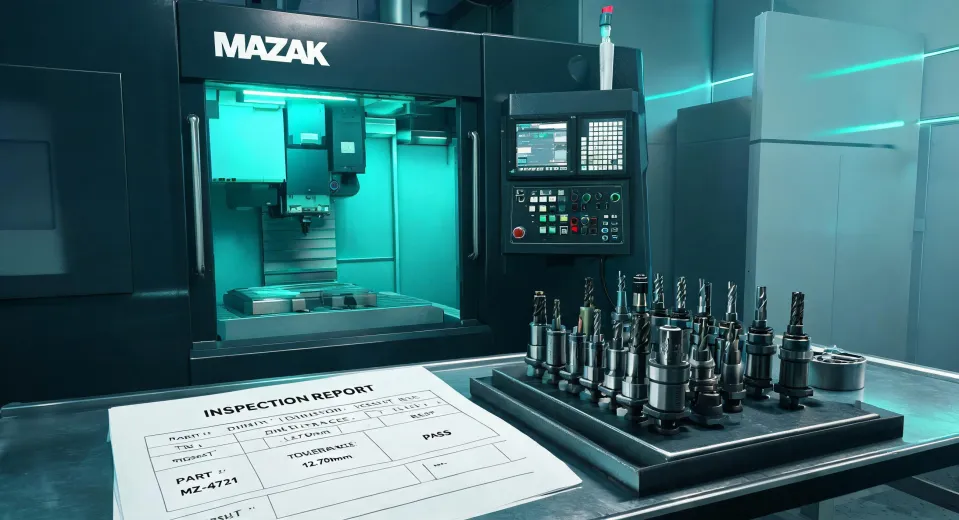
The lowest quote is usually the most expensive machine you'll ever buy. I know that sounds like a purchasing slogan. It isn't. After reviewing roughly 200 unique deliveries in 2024, I rejected 8% of first submissions because they didn't match the spec—and almost every rejection traced back to someone optimizing the wrong number: price per unit, not cost per year.
I'm a quality/compliance manager in a manufacturing plant that runs CNC equipment all day. My job is to make sure the thing that arrives matches the thing we agreed to buy. I've been doing it for six years. I don't get to fall in love with vendors. I get to live with the consequences of a bad purchase. That's why I care about total cost of ownership (TCO) more than the number on the price quote.
Yes, this article is about Mazak. But the framework applies to any capital equipment—and honestly, to a lot of other purchases too.
The TCO argument for a Mazak CNC mill
It's tempting to think you can compare machine tools by spindle speed, travel, and the spec sheet. But the spec sheet doesn't include the long-term costs: round-trip service, programming quirks, tool holding rigidity, control software upgrades, and the scrap that quietly disappears from your margin. The TCO calculation does.
In Q1 2024, I was part of a team evaluating five-axis machining options. The cheapest machine on paper would have saved us $38,000 upfront. But after adding tooling, post-processing, training, and expected maintenance over five years, the actual gap closed. And the Mazak CNC mill—not the cheapest—had one thing the others didn't: repeatability that survived heavy cutting without constant re-tramming. That's worth more than any initial discount.
TCO isn't just a finance exercise. It's a checklist. Does the machine require special electrical service? What's the floor footprint impact? How much do spare parts cost? What does training cost? What's the expected scrap rate in year two? When I put that list together for a Mazak CNC mill, I'm surprised how often a 'cheaper' competitor fails on one of those items.
Mazak support is not an afterthought
Support is a line item. When I call Mazak support, I'm not just asking for a part number. I need someone who can help me diagnose a chatter problem at 2 PM on a Tuesday without putting me in a callback queue for six hours. Over the last three years, Mazak support has consistently returned with either a documented procedure or a time slot for a remote session. That response time matters when a machine is down and the production schedule is real.
One example: during a Q2 2024 audit, we had an alarm code that the manual didn't explain. Support didn't say 'send us a log and we'll get back to you.' They walked through the diagnostic steps on the phone, and we found a bad proximity sensor. The part arrived the next morning. That's not a luxury item; that's a business continuation cost.
I'd argue that support is more valuable than any single feature on the control. A machine that goes down for two weeks can erase a year's worth of 'savings' from buying a cheaper unit. Good support keeps TCO in check.
"Before and after" photos hide the math
Here's where I probably lose some people. I don't trust the under eye CO2 laser before and after gallery any more than I trust a demo floor's "after" photo. Why? Because a photo is a selected frame, not a measured result.
If a vendor sends a before/after image, I ask three questions: What were the lighting conditions? Was the after image retouched? And is there any measurement data behind it? Those questions matter for cosmetic claims, and they matter for machining. If a machine owner shows me a beautifully finished part, I still want to see the Cpk values and the in-process measurement log. A high-resolution photo at 300 DPI may be print-ready—that's the commercial printing standard—but it doesn't prove diameter tolerance.
This is exactly why color standards matter. According to Pantone Color Matching System guidelines, brand-critical colors should stay within a Delta E of less than 2. A difference of 4+ is visible to most people. But plenty of suppliers send "close enough" parts and insist they're within tolerance. In machining, "close enough" is a scrap pile.
The paper analogy works too. Take two sheets, both perfectly square, both 8.5 x 11. One is 20 lb bond; the other is 100 lb cover. Same dimensions, completely different product. Identical materials and specs can behave differently based on internal structure. That's why I don't accept "we followed the dimensions" as the end of a quality conversation.
Plastic injection molding in Singapore taught me to add up every line item
Let's move from machine tools to sourcing. A few years ago, we obtained a quote from a plastic injection molding in Singapore supplier for a custom component. The line item was 14% lower than our local vendor. At face value, that looked like the smart choice.
It wasn't. After sea freight, customs clearance, documentation fees, and a single mold revision that required two-way shipping, the total cost was 11% higher. Worse, the revision cycle took 18 days instead of the four days our local vendor quoted. Time is also a cost. Now I calculate TCO before comparing any vendor quotes, and I ask every supplier to list transaction costs separately.
This isn't anti-overseas sourcing. It's anti-math-avoidance. If a vendor's quote is lower but the inspection, logistics, and risk costs aren't accounted for, you're not comparing quotes—you're guessing.
Can you leave resin in a 3D printer? The ownership question
A third example: "can you leave resin in 3d printer?" I get this question from our prototyping team often. The short answer is maybe, if you're talking overnight. The longer answer is that resin separates, pigments settle, oxygen inhibits cure near the surface, and the vat needs stirring or filtering before the next run. Leave it too long and you'll throw away resin, burn time, and possibly contaminate a print.
Same with a machine tool. You can skip coolant hourly checks, ignore chip accumulation, and postpone lubrication service. It will run for a while. Then the spindle decides otherwise, and the repair invoice dwarfs any "savings" from skipping the maintenance. Neglect is an ownership cost. It just arrives later.
Maintenance is boring. That's exactly why it gets skipped. At a previous shop, I watched a maintenance schedule get postponed for a month in the name of production. The resulting spindle repair cost roughly $11,000 and took nine days. We could have bought 40 hours of preventive maintenance visits at that price.
What about the budget argument?
To be fair, budgets are real. I know not every shop can buy the highest-spec machine on the first round. If you only plan to run a machine for 12 months and flip it, maybe the cheapest option is rational. But if you're running a production floor, you need a machine that holds tolerance after 10,000 hours, not just after the commissioning celebration.
Granted, this requires more thought before the purchase. You have to quantify downtime, scrap, support response, calibration, and training. But the effort pays off. In my experience, the "we'll fix it later" approach always costs more than the initial difference.
The bottom line
There's something satisfying about a procurement process that survives contact with reality. After all the stress and coordination, seeing a machine hold tolerance on its first audit—that's the payoff.
So here's my position. Don't buy a Mazak CNC mill because of the brand name. Buy it because you've added up the total cost of ownership, you've priced in Mazak support, and you've looked behind the before/after stories. A Mazak CNC mill won't eliminate every problem, but it removes a category of quality problems you don't need.
The quote sheet gives you the price. The after-photo gives you the illusion. TCO gives you the truth.