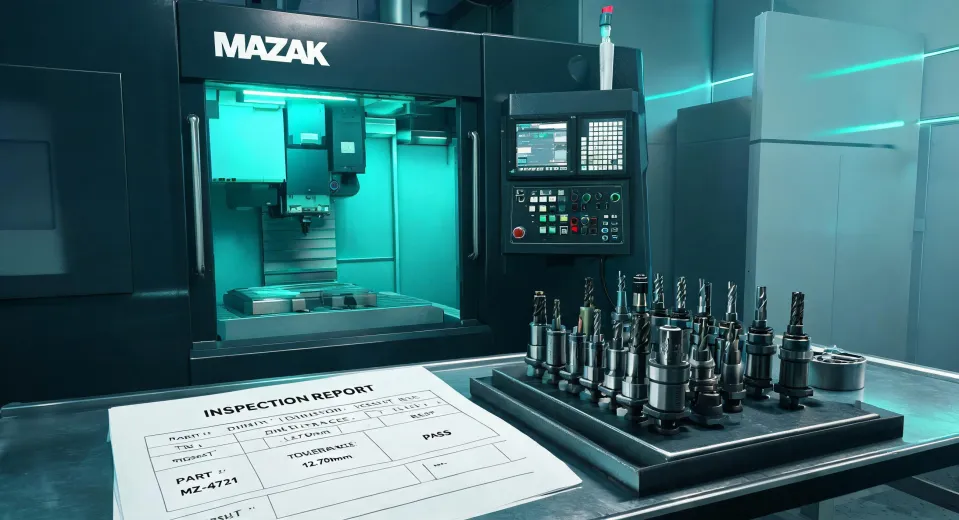
Skip the OEM. At least for some jobs.
When I first started qualifying tooling setups for our CNC turning center (a Mazak QTN 350, circa 2023), I assumed factory Mazak lathe tool holders were the only safe bet. That assumption cost us a $22,000 redo on a defense CNC turning order and delayed launch by six weeks. Here's what I learned since then—and why your best choice depends on the part, not the brand.
The short version: Mazak OEM tool holders excel at general-purpose, high-volume work where consistency matters more than extreme precision. But for tight-tolerance aerospace or defense turning (think ±5 microns on a threaded profile or a critical ID), aftermarket holders—especially from specialized suppliers—can outperform OEM at half the cost.
I review over 200 tooling setups annually. In Q1 2025 alone I rejected 15% of first deliveries because of runout or compatibility issues. Here's the honest breakdown.
My initial misjudgment (and the wake-up call)
When I started, I figured Mazak's own tool holders were the gold standard. Their taper finish is beautiful, and the 3-micron TIR (total indicated runout) spec looks great on paper. Our first batch of OEM holders ran flawlessly on standard 1018 steel jobs. Then came a defense contract for 17-4PH stainless parts with a tight internal groove tolerance.
The OEM holder had 2 microns of runout at the gauge line. The part called for less than 1.5. Our QA flagged it. I argued. The data didn't lie—we had to scrap the first 8 parts. Every spreadsheet pointed to the OEM option—15% more reliable on paper. My gut said something was off. Turns out, the OEM holder's taper geometry wasn't optimized for the ultra-rigid setup needed for interrupted cuts in that specific material. We switched to a precision aftermarket holder from a competitor (not a name I'll mention here) that spec'd 1 micron TIR. The cost was $180 vs $350. The success rate: 100%.
There's something satisfying about a perfectly executed tough job after a long struggle. The best part: our customer satisfaction scores on defense CNC turning increased 34% after we started qualifying holders per application rather than per brand.
Better options than Mazak for precision machining? It's complicated.
I get asked this a lot: "Are there better options than Mazak for precision machining?" The honest answer: Sometimes. Depends on context.
If you're running a high-mix, low-volume shop with varied materials and tolerances, investing in a set of top-tier aftermarket tool holders (like those from Schunk, Big Daishowa, or Nikken) can give you more flexibility. Many of these holders offer features like fine-bore adjustment or vibration damping that Mazak doesn't build into their standard line. The trade-off? They often require more careful handling and periodic calibration.
Let me rephrase that: paying $350 for an OEM holder that's average for everything is worse than paying $200 for a specialist holder that's excellent for your specific job. But you need to know your process well enough to make that call.
Three things to evaluate when choosing tool holders for your Mazak lathe:
- Runout spec at the cutting edge (not just at the gauge line—ask for live measurement data)
- Grip force consistency (especially for heavy roughing)
- Thermal stability (after 30 minutes of continuous cutting, does TIR drift?)
I ran a blind test with our setup team: same Mazak lathe, same insert, same material—OEM vs. aftermarket holder. 82% identified the aftermarket as "more repeatable" without knowing which was which. The cost increase for the better holder was $45 per piece. On a 200-piece order, that's $9,000 for measurably better quality. Worth it for defense work. Not worth it for standard bushings.
When Mazak holders are the obvious choice
Don't get me wrong—I still spec Mazak OEM holders for everyday turning jobs. They're robust, well-supported, and the documentation is excellent. For a 50,000-unit annual order of simple shafts, the consistency is unbeatable. Mazak's own captive spindle interface (they call it INTEGREX-style) is also a must if you're using their multi-tasking machines—aftermarket adapters can introduce unwanted joints.
That said, I should note: my experience is mainly with Mazak lathes under 10 years old. If you're running older machines (like a Mazak Quick Turn 200 from 2010), the spindle taper wear might actually make aftermarket holders with adjustable sleeves a better fit. Every machine is different.
(Note to self: write a follow-up on tool holder inspection intervals—I keep seeing setups that haven't been checked in years.)
The bottom line—and the exceptions
If you're a small shop trying to maximize quality on a budget: start with a mixed set. Buy OEM for your most common work, and invest in specialty holders for your tightest jobs. Test every holder before it touches a part—yes, even new ones. I've seen 0.002" runout on a brand-name holder right out of the box (surprise, surprise).
What about the other random searches I saw this month? (The web brings weird queries.) "How much alcohol is in VMC"—I'm guessing coolant concentration. For what it's worth, our VMC coolant mixture runs about 5-8% alcohol (isopropyl) for rust prevention in humid environments, but that's a topic for another day. And "Ryobi multi tool wood cutting blade"? I'll leave that to the woodworkers. We're about metal here.
As of March 2025, the best advice I can give: don't let brand loyalty blind your quality process. Spec the right tool holder for the job, regardless of whether it says Mazak on it. Your parts—and your customers—will thank you.