-
My TCO Conversion: When the "Expensive" Machine Was Actually the Bargain
-
CNC Turning Center Types: The Cost Question Nobody Answers Honestly
-
Fiber Lasers: Don't Buy the Pretty Pictures
-
Laser Welding Risks: It's Not the Laser That's Dangerous, It's the Process
-
Why 3D Printing Services Deserve a Line Item in Your Machining Budget
-
Counterargument: "Mazak Is a Premium Brand — My Shop Can't Afford It"
-
Big Vendors, Small Shops, and the Respect Problem
-
Bottom Line
I've managed procurement for a 40-person contract manufacturing shop for six years. In that time, I've documented every major purchase in our cost tracking system — machines, tooling, outsourced services, the lot. Roughly speaking, that's $180,000 in cumulative spend I can point to.
And the biggest mistake I see small shops make isn't buying the wrong brand. It's buying the cheapest quote and calling it "frugal."
I'd argue that mindset is exactly what keeps small shops small. Because the cheapest quote is almost never the cheapest. That's not a slogan. It's a pattern I've watched repeat across dozens of purchase decisions — and it's why I keep coming back to Mazak, a brand I once dismissed as overpriced.
My TCO Conversion: When the "Expensive" Machine Was Actually the Bargain
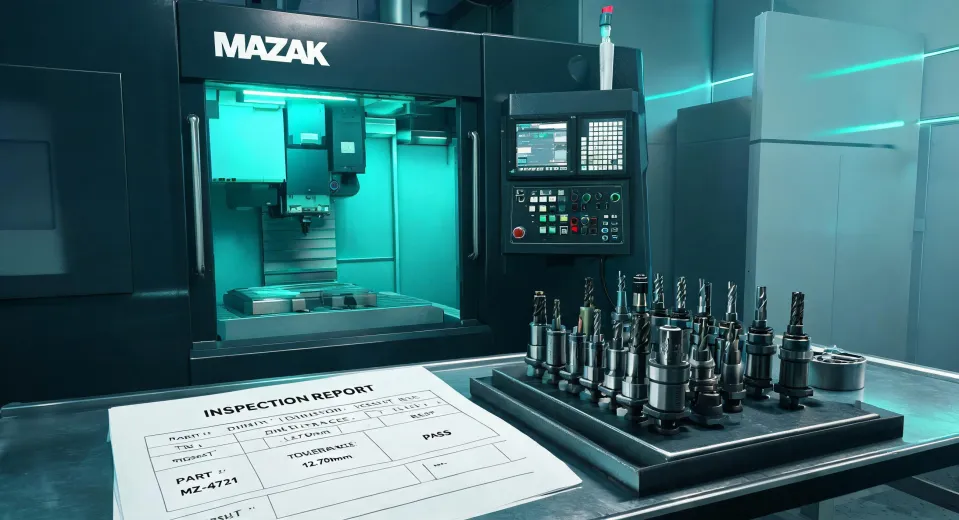
In 2021, I nearly bought a lesser-known CNC mill over a Mazak CNC milling machine. The quote was $28,000 lower, and I argued for it in three separate planning meetings. I was convinced the extra money was brand tax.
Then I ran the total cost of ownership (TCO) spreadsheet — the one I'd built after getting burned on hidden fees twice in my first year. The numbers changed my mind:
- The budget machine had lower spindle rigidity, which meant slower cycle times on our stainless fittings. Over 60,000 parts per year, that alone wiped out 40% of the upfront savings.
- It used a proprietary tooling system, locking us into a single supplier with no competitive pricing.
- Historical resale data I'd been tracking (based on our own sales records and industry listings, as of Q3 2022) showed the budget brand depreciating about 60% in five years. Mazak's held closer to 40%.
- Local service response for the budget brand: four days. For Mazak: about four hours. We couldn't afford four days of downtime.
When I totaled all of it, the "cheap" machine came out to $1.86 per part over a 10-year horizon. The Mazak? $1.42. That's a 23% difference — in favor of the machine that made our owner wince at the initial quote. We bought the Mazak in Q2 2023, and I've never regretted it.
CNC Turning Center Types: The Cost Question Nobody Answers Honestly
One of the most-searched phrases on our team's research list is "cnc turning center types." Every month, someone's trying to understand the difference between 2-axis, twin-spindle, and multi-tasking machines. And the reason they're searching is that most sales content explains specs, not cost implications.
Here's the thing most buyers completely miss: a 2-axis turning center is cheaper upfront, but if your parts need secondary milling, you're paying for a second machine, a second setup, and a second operator's time. A multi-tasking center — what Mazak calls "done-in-one" — might be double the price, but it eliminates that entire second operation.
When I compared quotes for a part that required drilling on three faces, the multi-tasking center paid for its premium in eighteen months. I documented that in our cost tracking system, line by line. (note to self: I still need to write up the 2024 training cost breakdown for that machine.)
So when people ask me which turning center type is best, I don't answer with spindle speed or axis count. I ask what their part mix looks like for the next five years, and then let the spreadsheet decide.
Fiber Lasers: Don't Buy the Pretty Pictures
A few months back, one of our engineers sent me a request for "immagine laser in fibra mazak" — Italian for "Mazak fiber laser image." He wanted to see the cut quality before we even talked budget. I get the appeal; the cut-edge photos look impressive.
But here's a hard lesson I learned in 2023: cut quality is the easiest thing to evaluate and the least useful predictor of long-term cost. Most buyers focus on beam quality imagery and completely miss the consumables line.
When I evaluated two fiber laser systems side by side, I tracked nozzle consumption per hour, assist gas cost per sheet, and how often the operator had to clean the cutting head optics. On paper, the two lasers were nearly identical. One had a $9-per-hour consumable cost. The other was $14. That's a difference of about $15,000 per year on a single shift. The pretty cut-edge image told me nothing about that.
This was accurate as of late 2024, and the market changes fast — so verify current rates before you budget. But the principle hasn't changed: a laser is a recurring cost machine, not a one-time purchase.
Laser Welding Risks: It's Not the Laser That's Dangerous, It's the Process
Another question I get constantly is "how to manage laser welding risks." Most people assume the risk is thermal damage or operator safety. Honestly, those are manageable with standard PPE and interlocks.
The real risks are porosity, inconsistent penetration, and poor fit-up — process control failures, not equipment failures. And the cost of getting it wrong shows up in scrap rates and rework, not in insurance claims. That "free setup" offer on a laser welder actually cost us $450 more in hidden testing when quality failed on the first batch.
If you're budgeting for laser welding, add 12–15% on top of the machine price for process development and operator training. I learned this the hard way in Q4 2024, when we had to redo a week's worth of parts because our penetration settings were wrong. That line item — the process learning cost — is the one most small shops refuse to budget for, and it's the one that bites hardest.
Why 3D Printing Services Deserve a Line Item in Your Machining Budget
This might be where I lose some readers, and I'm okay with that. I've been using 3D printing services in Seattle for quick-turn prototypes for two years now, and it's made me a better buyer of CNC machines.
Last year, a $350 prototype print order saved us from committing a $500,000 Mazak to a part that wasn't finalized. The engineer iterated three times on the printed version before we ever cut metal. That's not overspending. That's deferring a much larger cost until you have actual certainty.
In my opinion, a well-run small shop should have both: a high-precision CNC platform for production, and access to prototyping services that cost two orders of magnitude less per iteration. The shops that treat 3D printing as a threat to machining are the same shops that treat Mazak as "too expensive." Both attitudes come from the same place: fear instead of cost analysis.
Counterargument: "Mazak Is a Premium Brand — My Shop Can't Afford It"
Let me address the objection I hear most: "Mazak is a premium brand — perfect for big aerospace factories, not for my shop." Honestly, I used to agree with that. But after six years of tracking invoices, I've realized the total cost math doesn't care about brand perception. It cares about spindle hours, tooling compatibility, resale value, and support response times.
On all four, the premium machine won — not because the brand is cool, but because the machine was running when the alternative would've been down. The "cheap" option is only cheap in year one. After that, it's a discount on reliability that you pay for in cycle times, repair bills, and scrap rates.
Big Vendors, Small Shops, and the Respect Problem
There's another side to this that genuinely frustrates me. When we first reached out to machine dealers, a few dismissed us as too small to matter. I once had a salesperson tell me I should "grow into" a different brand first. That attitude is exactly why we built our recent relationship with a team that took our questions seriously — regardless of order size.
Here's my rule, and it's non-negotiable: if a vendor isn't willing to give the same technical depth for a $2,000 trial order as they would for a $200,000 one, I don't trust them on the big order either. Today's small order is next year's production line. Vendors who understand that build long-term relationships. Small doesn't mean unimportant. It means potential.
Bottom Line
If you're a small shop about to buy a CNC machine, stop asking "what's the cheapest option?" Ask what the total cost of that machine will be over the ten years you'll own it. Factor in tooling, cycle time, service response, and resale value. Do that math before you sign anything — and be honest with yourself about it.
The cheapest machine is rarely the best value. The premium machine is rarely the most expensive in the long run. And the vendor who respects your budget — whatever its size — is the one worth building a decade of orders around.
That's not just my opinion. It's what six years of spreadsheets say.