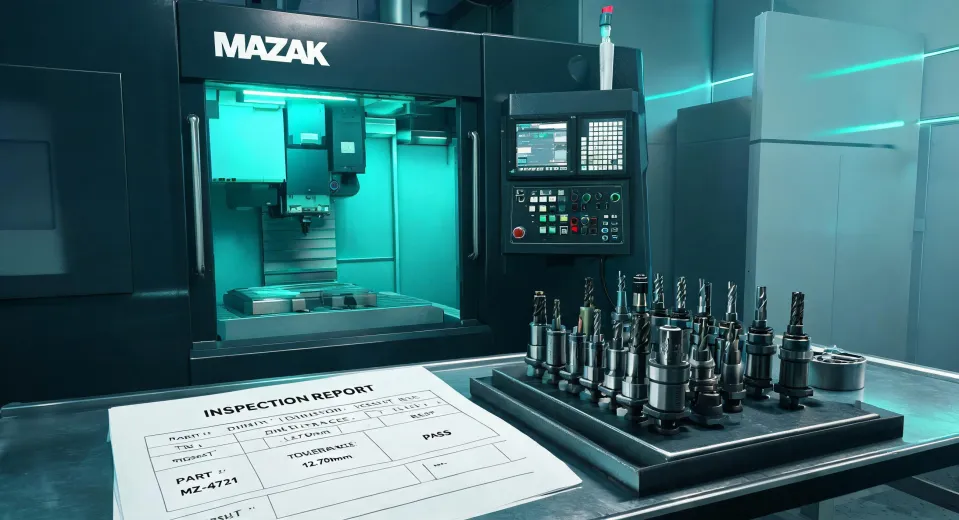
It was a Tuesday morning in April 2024 when the second Mazak laser nozzle in two weeks gave up mid-run on our fiber laser. Not a catastrophic failure—just a worn tip that started throwing a rough edge on the cut. The operator flagged it before it ruined the batch. That part was fine. But the replacement nozzle cost us $18 from the local distributor, and I happened to know third-party options existed at $9.
I ordered the OEM nozzle out of habit first. Then I spent an hour online, going deeper than usual, wondering whether brand loyalty was quietly costing us money.
That hour turned into a three-month investigation. It started with laser nozzles. It ended with a $357,000 equipment decision and an uncomfortable question: when someone searches for "better options than mazak for precision machining," are they looking for what I found—or what I almost committed to?
Let me back up.
I'm the procurement manager at a 60-person precision machining company. We make components for aerospace and automotive suppliers. I've managed our equipment and consumables budget—$1.2 million a year—for eight years. I've negotiated with 20+ machine tool vendors in that time and documented every order in our cost tracking system.
Our production floor runs five Mazak machines: two CNC lathes, two vertical machining centers, and a fiber laser. What we didn't have was pipes laser cutting capability. That became a problem when we won a contract that required it—as the RFP put it—for a defense supplier's subframe components.
The "Better Options" Search
I typed the phrase myself: "better options than mazak for precision machining." I'm not embarrassed about it. Challenging the default is part of my job.
The search results were noisy—listicles, forum threads, brand content from vendors I'd never considered. But there was enough substance to make the question worth a closer look.
So I built a comparison framework. My TCO spreadsheet, version 3 (version 1 was too basic; version 2 was too complicated to keep up). It had nine inputs:
- Purchase price
- Installation and rigging
- Training and ramp-up time
- Tooling and consumables (nozzles included)
- Planned maintenance
- Estimated downtime risk
- Post-processor / software compatibility
- Delivery date
- Resale value at 5 years
I compared six vendors over three months. I visited two trade shows. I sat through five sales presentations. And somewhere in the middle, I nearly talked myself into leaving Mazak.
Here's something vendors won't tell you: the first quote you get for a machine tool is rarely the complete picture. What most people don't realize is that "total cost of ownership" isn't a sales term—it's an accounting framework. If you don't build it yourself, the salesman will build it for you.
The Bordeaux VMC That Fired Up the Doubt
Right in the middle of the research, I flew to Bordeaux for a client meeting. An old colleague from my first job—André—runs a 12-person tool shop there. Over dinner, I asked about his equipment. He'd bought a non-Mazak VMC the year before.
"Paid 18% less than the Mazak quote," he said. "It's been excellent."
That statement hit me harder than any spec sheet. For two weeks, I walked around convinced that the Mazak premium was just nostalgia.
Then I visited his shop, and I saw what the 18% savings actually bought. The VMC was cutting parts that looked good. Surface finish was clean. Tolerances were within spec. But the post-processor had needed two days of tweaking before they could run a simple contour operation. The nearest certified technician was an hour away, and André had already paid for three service visits in the first year. And the coolant system was mounted externally—a small thing, but it ate floor space and created a trip hazard he was still working around.
André was happy with his machine. I believe him. But his parts weren't as complex as ours, his clients didn't demand the same certification trail, and his workload didn't push the machine's limits the way ours would. The VMC suited his floor. It wouldn't have suited ours.
Pipe Laser Cutting—Where the Cheap Option Fell Apart
The pipe laser cutting project was the real test. We needed a machine that could cut round and rectangular tube up to 6 meters long, with wall thickness from 1.5 to 12.7 mm. Tolerance requirements came from a print that specified ±0.05 mm on mating surfaces—right at the edge of what thermal cutting can hold.
The quotes came back. Mazak: $148,000, delivered in 10 weeks, installation and a 40-hour operator training program included. The alternative: $116,000, delivered in 14 weeks, installation extra at $4,200, training extra at $2,800.
At first glance, the alternative was $32,000 cheaper. If I hadn't built version 3 of my spreadsheet, I might have stopped there. At that point, every preliminary number pointed to the alternative. And my gut said something felt off.
It turned out my gut was reading the gaps in the quote—the stuff that wasn't in the brochure—before my spreadsheet caught up.
The alternative used cheaper laser nozzles—$6 each versus $18 for Mazak's. Sounds like a win, until you check the cut hours. The $6 nozzles averaged about 30% fewer cutting hours before the edge quality degraded. On the Mazak, we'd go through roughly two nozzles per 40-hour production week. The cheaper nozzles meant three per week. Annual nozzle cost:
Mazak: $18 × 2 × 50 weeks = $1,800
Alternative: $6 × 3 × 50 weeks = $900
Still a win for the alternative. Then came software.
Their post-processor was "compatible" with our CAM system—yes, but not fully. The sales rep said it "should work." The applications engineer who came on site said they'd "need to write some new post commands." The programming team quoted me eight additional engineering days to make the machine produce usable programs for our parts. At our loaded costing rate, that was about $6,400.
Then training. Their standard package was 16 hours, not 40. We'd need two extra days with the operator traveling to their facility—call it $2,300. And the warranty: the alternative covered 12 months, excluded the laser resonator, and required a $4,800/year preventive maintenance plan. The quote we received from Mazak covered 24 months with no mandatory service contract.
I ran the numbers again and again. By the five-year mark, the TCO difference was $7,500 in Mazak's favor. Not a massive gap. But add the shorter delivery window—the alternative was four weeks later, which mapped to about $4,300 in delayed production capacity—and the choice became obvious.
We bought the Mazak laser.
CNC Milling vs. Turning—A Different Kind of TCO
The laser decision wasn't the only one in flight. We also needed capacity for a new batch of rotary parts, and I kept coming back to a question I'd searched earlier in the year: cnc milling vs turning—which process do we actually need?
The old framing is a false dichotomy when a multitasking machine can do both in a single setup. But the budget question was real. Two machines (a VMC plus a turning center) came in at $173,000. One multitasking Mazak was $209,000.
The TCO spreadsheet caught this one too.
Running parts across two machines meant two setups. Two setups meant two chances to introduce error. It meant more floor space, more tooling inventory, more operator training, and more work-in-progress between operations. Our quality records showed that part transfer between machines accounted for about 30% of our historical rework events.
The multitasking machine removed that entire failure mode. It meant one operator instead of two, and it held tolerances with less thermal drift because the part wasn't moved between setups.
It felt counterintuitive to spend $36,000 more. But the five-year math favored the multitask machine by $11,200—before counting the cost of the rework we'd stopped chasing.
What the Search for "Better Options" Actually Taught Me
We bought the Mazak laser. We bought the multitasking Mazak. And I didn't just confirm an existing bias—I understood why the default existed in the first place.
Mazak is rarely the cheapest quote. That's by design, because they're selling uptime, support, and predictability. For shops running simpler parts, lower volumes, or looser tolerances, the alternatives we evaluated would probably do the job fine. André's shop in Bordeaux is proof.
But "better options than mazak for precision machining" isn't a search query with a binary answer. It's a calculation. The variables are part complexity, tolerance requirements, certification trail, operator familiarity, software stack, local support, and production schedule.
The mistake most of us make is treating "better" as a property of the machine. It's not. It's a property of the match between machine and context.
A few months later, I added a line to our procurement policy: any capital equipment purchase above $50,000 requires a five-year TCO comparison—not just a quote comparison. Estimated rework, changeover, and training costs must be included in the evaluation.
That policy is the reason we didn't save $32,000 upfront on the laser. It's also the reason the alternative's price advantage didn't survive contact with the spreadsheet—consumables, post-processor, training, service contracts, delivery delay. The 5-minute check that prevents a 5-day correction isn't a slogan in my spreadsheet—it's the whole point.
If you're researching machine tools and you've typed "better options than mazak for precision machining" into a search engine, keep going. Do the research. Build the spreadsheet. Run the numbers on consumables, post-processors, warranties, training, and downtime risk. You might land on a different conclusion than I did—or you might find a machine that genuinely serves you better. Both are valid outcomes.
The decision you want to avoid is the one made on a quote sheet, by habit, without a TCO check. That's the rework you can't afford.