-
Step 1: Start with the part, not the machine
-
Step 2: Match the process to tolerance and joining needs
-
Step 3: Match the tool to the material—and don't forget tooling
-
Step 4: Choose the machine platform once the process is clear
-
Step 5: Ask whether additive manufacturing is genuinely useful here
-
Step 6: Look at automation and data before you sign
-
Three mistakes that break this checklist
I'm a quality and brand compliance manager at a custom manufacturing company. I review every quote, spec, and first article before it reaches customers—roughly 300 items a year. In Q1 2025, I rejected 14% of first submissions. Missing tolerances, wrong material callouts, process mismatches. That last one is the reason for this article.
People choose the machine before they understand the part. Then they're surprised when the part costs three times more than expected. Here's the checklist I use when someone asks 'should we CNC this, laser this, or just 3D print it?' It's six steps, and step 3 is the one most shops ignore.
Step 1: Start with the part, not the machine
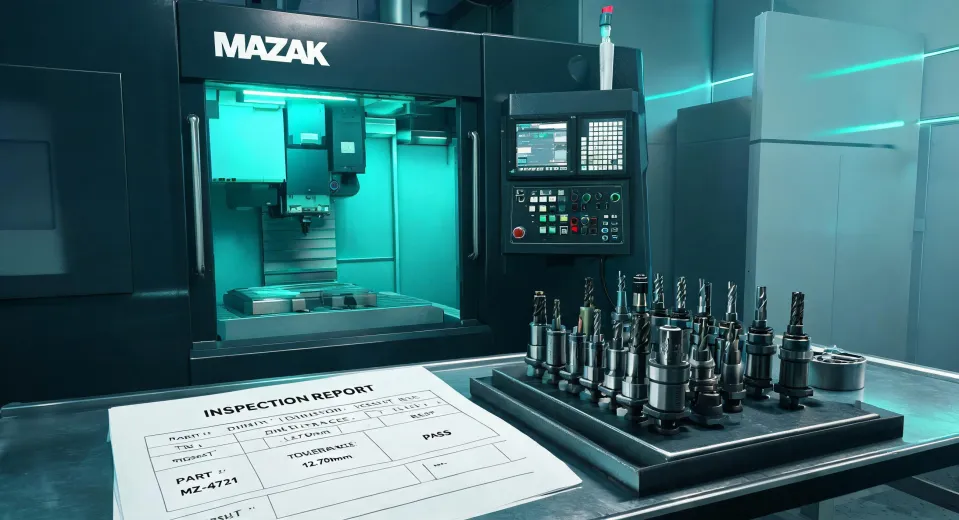
Before you ask about a Mazak CNC milling machine or a new laser welding machine, write down what the part actually needs. Material, geometry, quantity, tolerance, cycle time. That's it. If you don't know the tolerance, say so. 'This is a bracket, aluminum, 500 pieces, +/-0.5 mm' is enough to start. 'I want CNC' is not.
'I want CNC' is a machine decision, not a part decision. The machine should follow the part. It sounds obvious, but a lot of quotes arrive with a process already selected. When I ask why, the answer is usually 'because we have that machine.' That's a capacity problem, not a process solution.
Step 2: Match the process to tolerance and joining needs
Every process has a comfortable zone. A Mazak CNC milling machine is comfortable holding tight tolerances on metal parts—think +/-0.01 mm in the right setup. A new laser welding machine is not a magic box. It's for joining metal, sheet metal, or dissimilar materials with controlled heat input. It doesn't replace milling or turning. And 3D printers? Useful, but in a different zone.
Why are 3d printers useful? They let you see geometry before you commit to hard tooling. A printed fixture can be in your hand in hours. But that printed bracket will melt or bend in production if it's carrying real load. The part dictates the process.
I said 'production-ready.' The vendor heard 'yes, we can machine this.' Same words, different meanings.
Step 3: Match the tool to the material—and don't forget tooling
This is the step most people skip. You can put an expensive machine on a job and still fail with the wrong cutting tool. The tool is where the process meets the part.
Example: 'cement cutting tool' shows up on a purchase order. Does that mean a cemented carbide insert for machining, or a masonry blade for cutting concrete? I've seen both. If you're standing in front of a milling spindle, the wrong answer means chipped edges and a scrap bin. Be specific. Insert grade, corner radius, coating.
In my first year, I didn't know that. I assumed 'standard' meant the same thing to every supplier. It cost me a $600 redo. Now every contract includes the tooling spec. Not only the machine and the process, but the actual cutting edge.
Step 4: Choose the machine platform once the process is clear
Once you know the process, then you can compare machines. For metal removal with tight tolerances, look at a Mazak CNC milling machine. Mazak's range includes vertical, horizontal, and five-axis machines, so it's less 'which brand' and more 'which configuration.' For welding, a new laser welding machine might be justified if you have consistent joints and volume. For a low-volume shop, traditional TIG could be better—and cheaper.
I'd rather work with a specialist who knows their limits than a generalist who overpromises. That applies to machines too. A machine that can do everything is exciting, but it comes with complexity. Every axis, every option, every software module adds setup time. Sometimes a simple three-axis mill is the best tool in the room.
Step 5: Ask whether additive manufacturing is genuinely useful here
Every time a customer mentions 3D printing, I ask: useful for what? In 2024, we printed a conformal cooling fixture for a workholding clamp. It cut setup time by 22%. Never expected that. The surprise wasn't the printer itself; it was how much time it saved in the rest of the process.
So yes, additive manufacturing earns its place. But it's not a universal replacement. Why are 3d printers useful? They're useful where complexity is high, volume is low, and material requirements match what the printer can actually deliver. If you need 5,000 structural aluminum brackets, a Mazak CNC milling machine is still the realistic answer.
Step 6: Look at automation and data before you sign
Machine capability matters, but so does visibility. Mazak iSmart Factory is exactly the kind of thing a quality person should ask about. As of March 2025, Mazak's SmartFactory documentation describes iSmart Factory as a connected ecosystem—machine tools, automation, and digital monitoring. That's not just marketing. It gives traceability. You can see which program ran, which tool was used, and what the inspection data says. I've rejected fewer batches since we got digital tracking on the floor.
The cost of a machine is the price. The total cost includes tooling, programming, setup, maintenance, and the rework when something goes wrong. iSmart Factory helps you see those costs. Without that, you're flying on estimates.
Three mistakes that break this checklist
First, buying the laser because it's impressive. I get it. New capital equipment feels good. But if 80% of your work is milled aluminum, a laser welder is not the answer. It might be a useful addition, but not the core decision.
Second, assuming 3D printing equals cheap production. It can be cheap for one-offs. It's rarely cheap at 5,000 units. The geometry has to be right, the material has to be right, and the volume has to be low. That's the boundary.
Third, skipping tooling specs. The machine matters, the program matters, and the cutting tool matters. Don't just write 'cement cutting tool' and hope.
The pattern is simple. Process first, machine second, tooling third, data fourth. None of those steps has to be perfect. But if you skip one, you'll find out the way I did: with a rejected batch and an uncomfortable call to a customer.