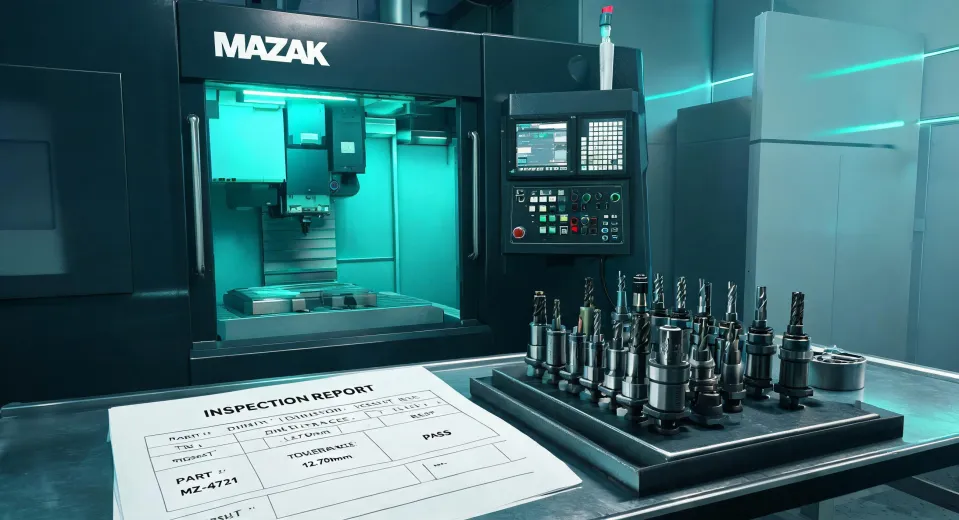
Bottom Line: Mazak Wins on Lifetime Efficiency, Not Just Sticker Price
After managing equipment purchasing for a 30‑person precision machining shop for five years, I'll cut straight to it: If you're looking for a CNC machine that balances upfront cost, internal build quality, and long‑term throughput, the Mazak lineup (especially their multi‑tasking machines) is a no‑brainer. We added a Mazak Integrex i‑200 last year, and it cut our cycle time on a complex aerospace bracket by 40%. That's not a marketing claim—it's a number I tracked on my own spreadsheet.
People often ask me about “mazak cnc machine internal” quality. The reality is Mazak uses rigid box‑way construction and thermal compensation that you don't see on cheaper imports. That matters when you're holding ±0.0002" tolerances day after day. And yes, the initial “mazak cnc mill cost” is higher than a comparable Haas or Doosan—but the real cost per part ends up lower because of reduced setup time, fewer rejects, and less maintenance downtime.
Why You Should Trust What I'm Saying
I'm not a sales engineer or a marketing copywriter. I'm the person who has to justify every capital purchase to our finance director and then live with the operational consequences. Since 2021 I've placed purchase orders for over $2 million in CNC equipment, managing relationships with 8 different vendors. When we evaluated the Mazak VCN‑430A vertical mill, I built a side‑by‑side total‑cost‑of‑ownership model that included tooling, power consumption, and projected maintenance. The Mazak came out ahead by about 18% over a five‑year horizon.
My experience is mostly with mid‑range production shops (20–50 employees). If you're running a job shop with constant change‑overs or a high‑volume automotive line, your numbers might differ. That's a boundary I'll come back to later.
The Internal Story: What Makes a Mazak CNC Machine Tick
When you look inside a Mazak CNC machine, you see what the extra money buys: massive cast‑iron structures, hardened and ground box ways (on most models), and a spindle that's built for heavy‑duty cutting. Our Integrex has a 50‑hp, 4,000‑rpm built‑in motor spindle that doesn't lose torque at low speeds. That internal design translates directly to faster roughing passes and better surface finishes. It's not glamorous, but it's the reason the machine holds alignment for years.
Mazak's SmartFactory software is another internal differentiator—it actually works. We connected the Integrex to our ERP system, and it automatically downloads tool offsets and part programs. That eliminated a data‑entry error that used to happen about once a month. Honestly, the software integration alone saved us roughly 6 hours of manual programming per week.
How Laser Welding and 3D Printing Fit Into Our Shop
I get questions about “laser welder for sheet metal” and “3d printing parts for cars” from colleagues who think additive is going to replace CNC. Here's the reality: we added a fiber laser welder for sheet metal enclosures, and it's a great complement to our Mazak line—but it's not a replacement. For structural automotive parts that need strength and tight tolerances, you still need chip‑making. The laser welder is for thin‑gauge cabinets and brackets that we used to TIG weld; it's faster and leaves no distortion.
As for 3‑D printing, we experimented with a small polymer printer for prototypes and some non‑structural interior car parts (like ductwork). It's useful for iteration, but the surface finish and material properties aren't ready for production runs. If someone asks “what is laser co2?”—it's a gas‑based laser that's good for cutting wood and plastics, but for sheet metal you want a fiber laser. We stuck with fiber for our welder.
So the bottom line: Mazak handles the heavy, precise work. Laser welding handles thin materials fast. 3D printing handles early prototypes. No single technology does it all, and that's okay.
Boundary Conditions: When a Mazak Might Not Be Your Best Bet
I don't want to sound like a fanboy, so let me be honest about where our Mazak strategy has limits. If your shop only runs one‑off custom parts with no repeat orders, the high initial investment in a multi‑tasking machine might not pay back. A simpler manual lathe or a used 3‑axis mill could be smarter. Also, if you're a startup with tight cash flow, the Mazak premium can hurt. We financed our Integrex over 5 years, and the monthly payment eats into margins until the machine is loaded.
Another thing: this pricing was accurate as of early 2025. The machine tool market changes fast—steel tariffs, shipping costs, currency fluctuations—so verify current quotes before budgeting. My experience is also based on buying from the regional Mazak distributor in the Midwest; other regions might have different service quality.
Finally, if you only need a low‑volume CO2 laser for cutting acrylic signs, don't buy a Mazak laser. Their laser line is built for industrial cutting and welding. That's why I mentioned “what is laser co2” earlier—know your application before you invest.
Overall, for a mid‑size shop that values throughput, precision, and long‑term reliability, a Mazak CNC machine is a solid bet. Just don't expect it to solve every problem, and make sure you run your own numbers.